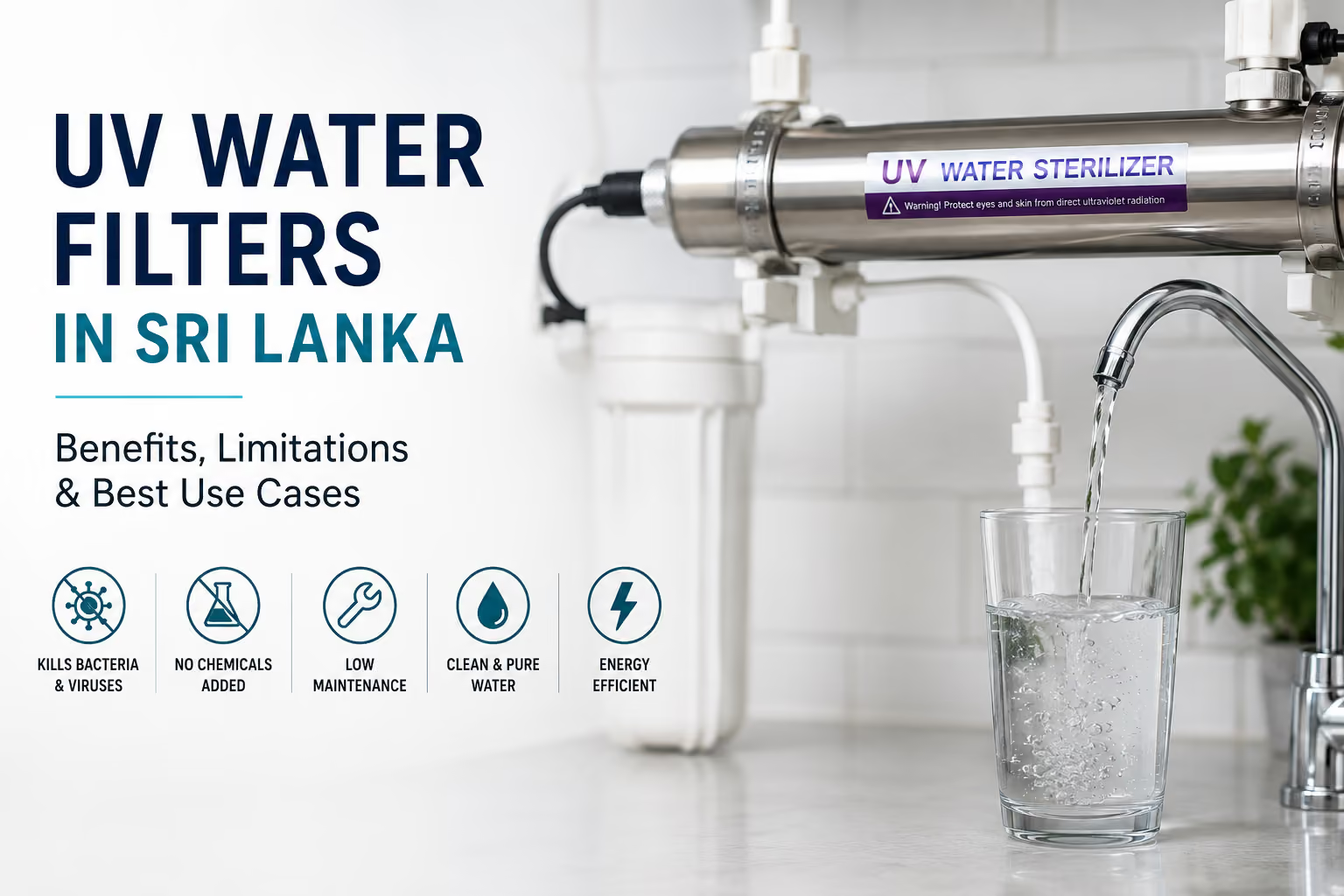
UV water filters in Sri Lanka are becoming an increasingly common choice for households and businesses looking to improve drinking water safety without chemicals or complex installation. But like any water treatment technology, UV purification has specific strengths, real limitations, and use cases where it performs better than others.
Understanding what UV water filters actually do — and what they don't do — is what allows you to make the right decision for your household's specific water quality needs.
This guide covers how UV filtration works, its key benefits and limitations, the best use cases for UV systems in Sri Lanka, and answers the questions most frequently searched before choosing a UV-based water purifier.
UV (Ultraviolet) water purification works by exposing water to ultraviolet light at a specific wavelength — typically 254 nanometres — which damages the DNA of microorganisms passing through the chamber. Bacteria, viruses, cysts, and other pathogens are rendered unable to reproduce, effectively neutralising them without adding any chemicals to the water.
The process is fast, continuous, and leaves no chemical residue in the treated water. Most UV systems consist of a UV lamp housed inside a stainless steel or clear chamber through which water flows before reaching the tap or dispenser.
Importantly, UV purification is a disinfection technology, not a filtration technology. It does not remove dissolved solids, heavy metals, sediment, chlorine, or chemical contaminants — which is why UV is almost always used alongside other filtration stages in a complete water purification system.
UV is one of the most reliable methods for neutralising bacteria, viruses, and cysts — particularly valuable for Sri Lankan households relying on well water, borewell water, or areas with distribution network vulnerabilities.
Unlike chlorination, UV adds nothing to the water — no taste, no odor, no residue — making it suitable for households sensitive to the taste of chemically treated water.
UV systems require mainly an annual lamp replacement and occasional quartz sleeve cleaning — significantly simpler than maintaining multiple RO cartridges.
UV purification is instant — no waiting period, no storage tank required for the UV process, and no reduction in water flow during treatment.
No chemical byproducts, no contaminated waste water (unlike RO), and low electricity consumption make UV one of the more environmentally efficient water treatment options.
For households with low-TDS water primarily needing microbial protection, UV delivers highly effective disinfection at a lower system cost than a full RO setup.
UV neutralises microorganisms but has no effect on dissolved minerals, heavy metals, chlorine, or chemical contaminants. If your water has high TDS or known chemical contamination, UV alone is not sufficient.
UV light is blocked by turbidity — suspended particles reduce UV penetration and allow microorganisms to pass through unaffected. A sediment pre-filter is always essential before the UV chamber.
Lamps degrade gradually even when still visibly glowing. Most should be replaced annually or after approximately 9,000 hours — reduced UV output means reduced disinfection performance regardless of appearance.
UV systems require electricity to operate, meaning protection is inactive during power interruptions — a relevant consideration in areas with less stable supply.
UV damages pathogen DNA but does not physically remove organisms from the water. They remain present but are no longer capable of reproducing or causing infection.
Municipal water with biological risk — UV works strongly as a final disinfection stage for households on chemically treated municipal supply where post-treatment biological risk during distribution is a concern.
Homes with low-TDS well or spring water — For natural water sources with low dissolved solids but biological contamination risk, UV plus a sediment pre-filter provides effective protection without the cost of a full RO system.
As part of a multi-stage RO system — UV is most effective as one stage within a combined RO, UV, and UF system, handling biological disinfection while RO addresses dissolved solids and chemical contaminants.
Offices and small commercial settings — Higher flow-rate UV systems suit offices and small businesses needing reliable biological protection at a communal water point.
As a backup disinfection layer — Even in RO-equipped homes, UV adds assurance against biological contamination entering the system through the storage tank or distribution lines after the membrane.
Identify whether your concern is biological (bacteria, viruses) or chemical/physical (dissolved solids, heavy metals, chlorine). UV addresses the first; RO or carbon filtration handles the second.
UV is only effective in clear water. Visible sediment or turbidity requires a sediment pre-filter before the UV chamber — if turbidity is consistently high, a multi-stage system is more appropriate.
UV systems are rated by flow rate. Choose a system rated for your household's peak usage, not just average, to ensure effective UV exposure at all times.
Low-TDS water with primarily biological risk may suit a standalone UV plus pre-filter. Hard water, high TDS, or chemical contamination requires a multi-stage RO and UV combination.
UV lamps need replacing every 12 months regardless of visible appearance. Include this in your annual cost-of-ownership calculation from the start.
In areas with frequent outages, plan for how drinking water will be managed when UV is inactive — through stored water, a UPS, or a complementary non-electric filtration option.
Water quality varies significantly across Sri Lanka by region and source. PureHydro's range of water purifiers includes UV, RO, and multi-stage options suited to different water profiles and household sizes — with expert guidance to match the right system to your needs.
If you're looking for a system that includes UV filtration, here are the most relevant options currently available through PureHydro:
Kent Maxx — UV + UF Water Purifier — LKR 43,900 A UV and UF combined purifier delivering 70L per day, suited for medium-sized families of up to 10 people. Removes pathogens and sediments without an RO membrane — ideal for households with clean, low-TDS municipal water primarily needing biological protection.
Kent Excel Plus — RO + UV + UF with TDS Control — LKR 79,000 A multi-stage RO, UV, and UF system with TDS control producing 75L per day for up to 15 people. Combines dissolved solid removal with UV disinfection — well suited for households and offices with harder or more contaminated water sources.
Kent Grand Plus — RO + UV + UF with Mineral Retention — LKR 87,093 A premium RO and UV purifier with mineral retention technology producing 100L per day for up to 20 people. Trusted by hotels and restaurants, and equally suited to larger households needing comprehensive purification with balanced mineral output.
Kent Crystal Star — RO + UV + UF with Smart TDS Management — LKR 83,636 An energy-efficient RO and UV purifier with smart TDS management producing 100L per day for up to 20 people — a compact, elegant solution for homes and offices.
Kent Crown Plus — RO + UV + UF with TDS Control — LKR 83,636 A sleek, wall-mounted RO, UV, and UF purifier with TDS control producing 100L per day for up to 20 people. Removes bacteria, viruses, heavy metals, and chemicals while retaining essential minerals.
Kent Prime TC — RO + UV + UF with Mineral RO Technology — LKR 94,000 An advanced multi-stage purifier with patented Mineral RO technology and a transparent design showcasing the filtration stages, producing 100L per day for up to 20 people — ideal for households and offices wanting the most thorough purification with mineral balance.
H20 PureHydro Dispenser — RO + UV + UF + Carbon — LKR 124,900 A 6-stage purification dispenser combining RO, UV, UF, carbon, and post-carbon filtration, producing 120L per day. Removes 99.9% of impurities — suited to larger households, offices, schools, hospitals, and hotels needing high-capacity, comprehensive purification.
H04 PureHydro Dispenser — RO + UV + Carbon — LKR 142,900 A compact 5-stage RO and UV dispenser with carbon filtration producing 120L per day, suitable for households, institutions, hospitals, and offices. Combines strong biological and chemical purification in a high-capacity dispenser format.
PureHydro Blue Wave — Commercial RO + UV System — LKR 135,000 A commercial-grade RO and UV system producing 1,200L per day for up to 500 people — designed for schools, factories, hotels, and larger institutions needing industrial-scale UV-enabled purification.
1. Are UV water filters effective for drinking water in Sri Lanka? Yes — UV water filters in Sri Lanka are highly effective at neutralising bacteria, viruses, and cysts, particularly when combined with sediment and carbon pre-filtration.
2. Do UV water filters remove dissolved salts and heavy metals? No. UV only neutralises microorganisms — it has no effect on dissolved solids, heavy metals, or chemical contaminants. RO filtration is needed for those.
3. How often does a UV lamp need replacing? Annually or after approximately 9,000 hours — regardless of whether it still appears to glow, since UV output degrades before visible light output does.
4. Can UV filters work without electricity? No. UV requires continuous power to operate — during outages, the lamp is inactive and water is not being disinfected.
5. Is UV better than RO for drinking water in Sri Lanka? They address different concerns. UV handles biological disinfection; RO removes dissolved solids and chemical contaminants. For most households — especially with well or borewell water — a multi-stage system combining both offers the most complete protection.
6. Does UV-treated water taste different? No — UV adds nothing and removes nothing, so taste is unaffected. For taste improvement, a carbon filter stage should be added to the system.
7. What is the best filter combination for Sri Lankan households? A multi-stage system combining sediment filtration, carbon filtration, RO membrane, UV disinfection, and UF provides the most comprehensive protection against both biological and chemical contaminants.
UV water filters in Sri Lanka offer a fast, chemical-free, and effective solution for biological disinfection — but their value is greatest when used as part of a well-matched, multi-stage system rather than as a standalone solution for all water quality concerns. Understanding what UV does and doesn't address is what ensures your household gets the right level of protection for its specific water source.
PureHydro offers a range of UV, RO, and multi-stage water purification systems designed for Sri Lankan homes, offices, and commercial settings — with expert guidance to help you match the right system to your water quality needs.
Not sure whether UV alone or a multi-stage system is right for your home? Get in touch with our team for personalised advice.