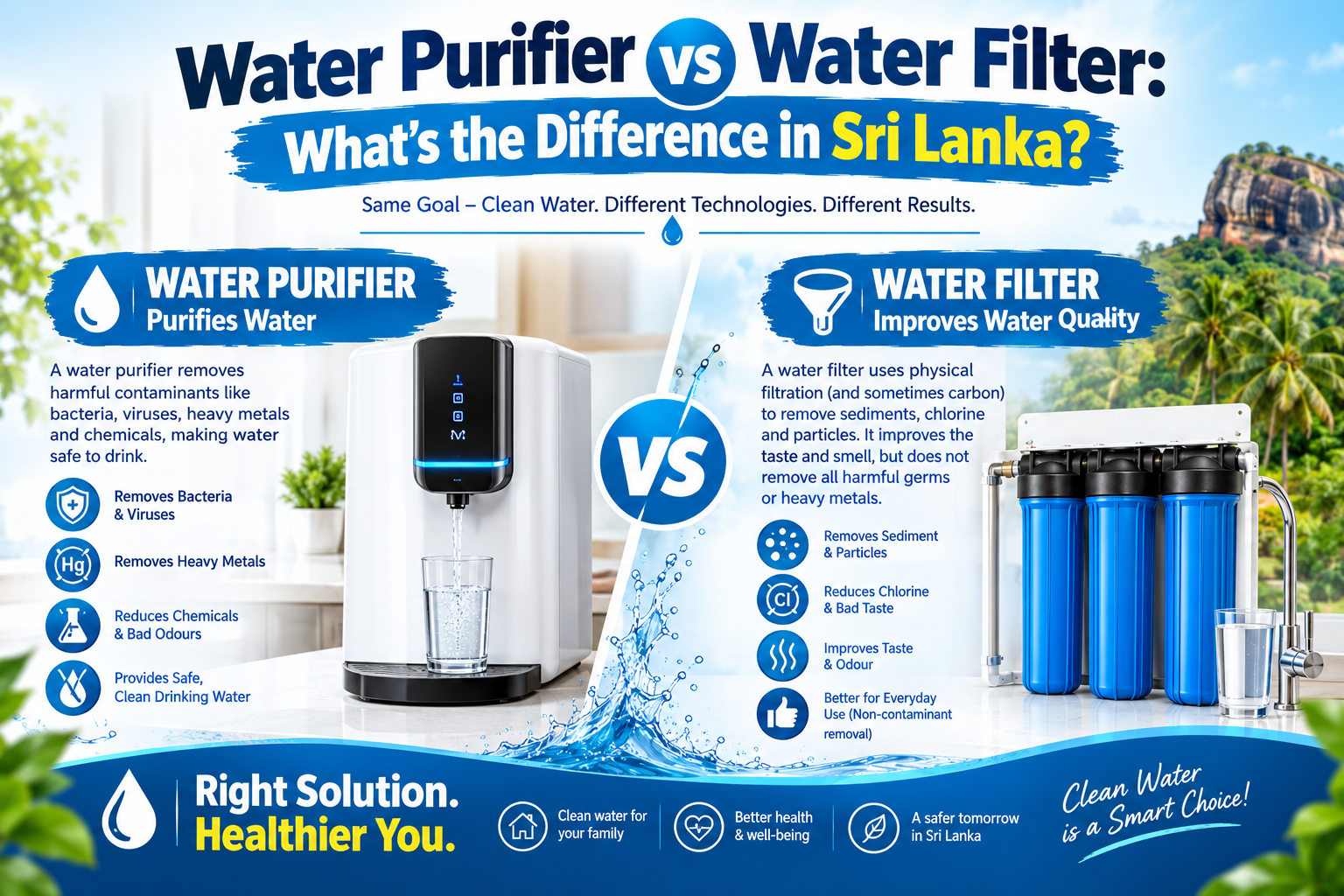
Walk into any appliance store in Sri Lanka and you will hear the words "water filter" and "water purifier" used as if they mean the same thing. They do not. While both improve your drinking water, they remove very different contaminants. Choosing the wrong one could leave harmful bacteria, viruses, or dissolved salts in the water your family drinks every day. In this guide, Purehydro explains the real difference between a water purifier and a water filter, and how to decide which one your home or business needs.
The main difference in Water Purifier vs Water Filter is what they remove. A water filter physically removes sediment, dirt, rust, chlorine, and bad taste or odour, but may not remove all harmful microorganisms or dissolved salts. A water purifier uses technologies such as UV, UF, and RO to eliminate bacteria and viruses and, in RO models, remove dissolved salts, hardness, fluoride, and heavy metals. For treated tap water, a filter may be enough; for well water or high-TDS water, a purifier is recommended.
A water filter works like a physical barrier. As water passes through the filter media, particles and certain chemicals are trapped. Common types include:
Water filters are affordable, easy to maintain, and often need no electricity. However, most basic filters do not guarantee protection from bacteria and viruses, and they cannot remove dissolved salts or hardness.
A water purifier goes a step further. It is designed to make water safe to drink by removing or inactivating disease-causing microorganisms, and in many cases, dissolved contaminants too. Common purification technologies include:
Most modern purifiers combine these technologies with sediment and carbon filters in a multi-stage system.
A water filter can be a suitable choice if:
A water filter pitcher is a convenient way to improve the taste of tap water for small families. However, if there is any risk of bacterial contamination, a purifier offers far better protection.
A water purifier is the better choice if:
For low-TDS tap water with microbial risks, a UV + UF water purifier provides strong protection against bacteria and viruses. For hard or high-TDS well water, an RO + UV + UF purifier with mineral retention is usually the most complete solution.
Myth 1: Clear water is safe water. Bacteria, viruses, fluoride, and dissolved salts are invisible. Clear water can still be unsafe.
Myth 2: Boiling makes water completely safe. Boiling kills germs but does not remove dissolved salts, heavy metals, fluoride, or chemicals.
Myth 3: RO removes all healthy minerals. Modern RO purifiers with TDS control or mineral RO technology help retain essential minerals and improve taste.
Myth 4: Every home needs an RO purifier. RO is best for high-TDS water. For low-TDS tap water, UV + UF is often more suitable.
Water filters mainly need regular cartridge changes, often every 1 to 6 months depending on the type. Water purifiers need scheduled replacement of sediment and carbon filters, UV lamps, and UF or RO membranes, typically every 6 to 12 months for most cartridges. Professional servicing helps keep purifiers working at their best.
An RO system is a water purifier. It removes dissolved salts, heavy metals, and many microorganisms, and is often combined with UV for extra protection.
Basic sediment and carbon filters do not reliably remove bacteria. UF membranes, UV, and RO systems are designed for microbial protection.
Tap water is treated, but contamination can occur through pipes and storage tanks. A UV + UF purifier adds reliable protection.
For most Sri Lankan homes, especially those using well water, a water purifier offers safer drinking water. A filter may be enough for treated tap water with only taste issues.
Gravity-based UF purifiers can work without electricity, but UV and RO purifiers need power.
What is the main difference between a water purifier and a water filter? A filter removes particles and improves taste, while a purifier also removes or inactivates microorganisms and, in RO models, dissolved contaminants.
Is a water purifier more expensive than a filter? Yes, purifiers usually cost more upfront, but they provide much broader protection.
Which is best for well water? An RO + UV purifier with TDS control is usually best for hard or high-TDS well water.
Which is best for offices and schools? High-capacity RO + UV purifiers or commercial RO systems suit offices, schools, and institutions.
How do I know which one I need? Test your water source and TDS level, or ask a water purification expert for advice.
Purehydro offers a complete range of Purehydro and Kent water filtration and purification solutions in Sri Lanka. From affordable water filter pitchers and under-sink filters to RO + UV + UF dispensers and industrial RO plants, we help homes, offices, schools, hospitals, hotels, and factories find the right solution. Our team provides expert recommendations, professional installation for select models, and warranty-backed products.
Understanding the difference between a water purifier and a water filter helps you make a smarter, safer choice for your family or business. Contact Purehydro today for expert advice and find the right water solution for your water source.