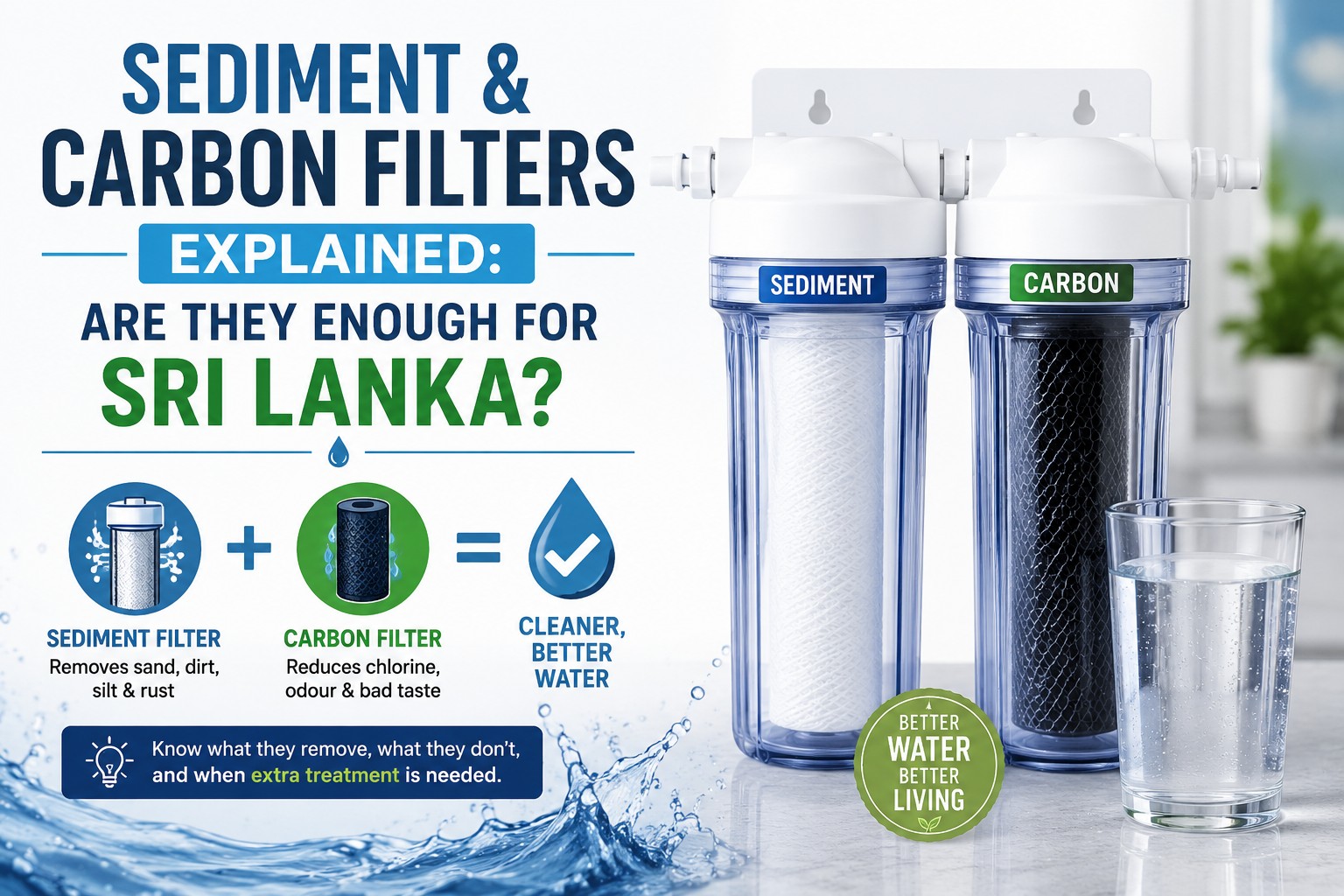
Water quality can vary significantlybetween households in Sri Lanka. A property supplied by treated municipal watermay have different water-quality concerns from a home using a well, borehole oranother private water source.
When homeowners start looking for a waterfiltration solution, two of the most common technologies they encounter are SedimentFilters / Carbon Filters.
These filters can be highly useful forspecific water-quality problems. Sediment filtration can reduce physicalparticles such as sand, dirt and rust, while activated carbon can help reducechlorine, certain organic compounds, unpleasant tastes and odours.
But are they enough?
Sometimes yes, but not always.
The right answer depends on the sourceand quality of your water, what contaminants are present, and whether the wateris intended for drinking, bathing, cooking or general household use.
This guide explains how sediment andcarbon filtration works, what each filter can and cannot do, when they may besufficient, and when additional water treatment may be necessary.
Sediment filters are designed tophysically capture suspended particles in water.
Depending on the filter's micron ratingand design, sediment filtration can reduce materials such as:
● Sand
● Dirt
● Silt
● Rust particles
● Suspended solids
● Other visible or microscopicparticles
A sediment filter is often used as a pre-filterbecause it protects other treatment equipment from larger particles.
For example, if incoming water containssignificant amounts of sand or dirt, installing a sediment filter before anactivated carbon filter can help prevent the carbon filter from becoming cloggedtoo quickly.
Most sediment filters work through physical filtration.
Water passes through a filter mediumcontaining pores or filtration structures. Particles larger than the filter'seffective filtration capability are trapped while water continues through thesystem.
The filter's micron rating is important.
A lower micron rating generally means thefilter is designed to capture smaller particles, although actual performancedepends on the filter technology, water pressure, flow rate and particlecharacteristics.
Carbon filters use activated carbon toadsorb certain contaminants and compounds from water.
Activated carbon has a highly porousstructure that provides a large surface area for adsorption.
Carbon filtration is commonly used toimprove:
● Taste
● Odour
● Chlorine-related smell
● Chlorine-related taste
● Certain organic compounds
● Some other chemical compounds,depending on the carbon and system design
Carbon filtration is particularly usefulwhen the main complaint is that tap water has an unpleasant taste or smell.
When water passes through activatedcarbon, certain compounds interact with the carbon surface and become adsorbed.
This is different from sedimentfiltration.
A sediment filter primarily capturesphysical particles, while activated carbon targets certain dissolved compoundsand chemicals.
This is why the two technologies areoften used together.
Understanding the difference is essentialwhen choosing a water filtration system.
Neither technology should be treated as auniversal solution for every water-quality problem.
It depends on the problem.
If the main issue is visible sediment,sand or dirt entering the property, a properly sized sediment filter mayprovide an effective solution.
For example, a household supplied by aprivate water source may notice particles collecting in taps, showerheads orstorage tanks.
A sediment filter can help reduce theseparticles before the water enters the household plumbing system.
However, sediment filtration does notaddress every potential water-quality concern.
It generally does not remove dissolvedsalts, hardness, many chemicals or microorganisms simply because thosesubstances are present in dissolved or microscopic form.
Therefore, if water testing identifiesother problems, additional treatment may be necessary.
Carbon filtration can be effective when the main concernsare chlorine, taste and odour or certain organic compounds.
For example, if treated water has anoticeable chlorine smell, an appropriate activated carbon system maysignificantly improve the sensory quality of the water.
However, carbon filtration also haslimitations.
A standard carbon filter should notautomatically be assumed to remove:
● All bacteria and viruses
● Hardness
● High levels of dissolved salts
● Every heavy metal
● Nitrates
● All pesticides or chemicals
● Every possible contaminant
The exact performance depends on the typeof activated carbon, filter design, contact time, flow rate and contaminantconcentration.
This is one of the most importantquestions.
Sedimentand carbon filtration together can provide useful treatmentfor many common household water-quality concerns, but they are not a completesolution for every water source.
A typical combination may look like:
IncomingWater → Sediment Filter → Carbon Filter → Household Distribution
The sediment filter removes physicalparticles first.
The carbon filter then treats certainchemical compounds and helps improve taste and odour.
This combination can be an effectivebasic filtration arrangement when the water does not contain contaminantsrequiring specialised treatment.
However, if testing reveals highhardness, iron, manganese, dissolved solids or microbiological contamination, anothertreatment technology may be required.
Choosing the right filtration systemshould begin with the water rather than the product.
Determine whether your home receiveswater from:
● Municipal supply
● Well
● Borehole
● Water storage tank
● Rainwater system
● Another private source
Different sources can have differentwater-quality characteristics.
Ask what you are experiencing.
Is there:
● Visible dirt?
● Sand?
● Rust-coloured particles?
● Chlorine smell?
● Bad taste?
● Hard-water scaling?
● Staining?
● Unusual colour?
● Uncertain water quality?
This initial assessment helps identifywhether sediment or carbon filtration may be relevant.
Water testing is one of the most usefulsteps before investing in a filtration system.
Depending on your source and concerns,testing may assess:
● pH
● Turbidity
● Hardness
● Iron
● Manganese
● Total dissolved solids
● Chlorine
● Microbiological indicators
● Other relevant parameters
Testing is particularly important forwells and boreholes because water quality can vary from one location toanother.
If the main problem is suspendedparticles, consider sediment filtration.
If chlorine taste and odour are the mainconcerns, activated carbon may be appropriate.
If multiple problems are identified, amulti-stage treatment system may be more suitable.
The filter should be sized according tothe property's water usage.
Consider:
● Number of residents
● Number of bathrooms
● Number of taps
● Peak water demand
● Water pressure
● Pipe size
An undersized filter can restrict flow orrequire frequent replacement.
Ask whether you need filtration for:
● Drinking water only
● Kitchen water
● Bathroom water
● The entire house
A point-of-use system may be enough fordrinking water, while a whole-house system may be more appropriate whenwater-quality concerns affect multiple outlets.
Every filtration system needsmaintenance.
Understand how often the filter needsreplacement and how much replacement cartridges or media will cost.
If water testing identifies contaminantsthat sediment and carbon filtration cannot adequately address, additionaltreatment should be considered.
This could include technologies such aswater softening, iron removal, UV treatment, ultrafiltration or reverseosmosis, depending on the actual water-quality problem.
There are several situations whereadditional treatment may be required.
Hard water contains elevatedconcentrations of calcium and magnesium.
Sediment and carbon filters do notnormally soften water.
If you see scale developing on kettles,bathroom fixtures or heating equipment, water hardness may need to beinvestigated.
A dedicated water-softening system may bemore appropriate.
Some groundwater sources can containelevated iron or manganese.
These can cause staining, unpleasanttaste or other problems.
Standard sediment and carbon filters maynot be sufficient for significant concentrations.
Specialised treatment may be required.
If water contains harmful bacteria orother microorganisms, standard sediment and carbon filtration should notautomatically be considered sufficient.
Depending on the water source and testresults, disinfection technologies such as UV or other appropriate treatmentmay be required.
TDS represents the concentration ofdissolved substances in water.
Sediment filters generally do not removedissolved salts, and standard carbon filtration is not designed tosignificantly reduce overall TDS.
Where dissolved solids are a concern,membrane technologies such as reverse osmosis may be considered for appropriateapplications.
Certain dissolved contaminants requirespecific treatment technologies.
A standard sediment-plus-carbonarrangement should not be assumed to remove them.
This is why water testing is important.
Not necessarily.
Well water can contain differentcontaminants depending on the geological and environmental conditions aroundthe water source.
Sediment and carbon filters may improvecertain physical and sensory characteristics, but they do not automaticallymake every private water source safe for drinking.
If well water is intended forconsumption, testing should be considered before selecting a treatment system.
The appropriate treatment should then bebased on the test results.
Activated carbon is commonly used toreduce chlorine and associated taste and odour.
However, performance depends on thecarbon type, filter size, water flow, contact time and chlorine concentration.
A properly designed carbon filtrationsystem can therefore be useful when chlorine is the primary concern.
No, not normally.
Sediment filters remove physicalparticles, while activated carbon primarily targets certain chemicals andcompounds.
Neither standard sediment filtration norstandard carbon filtration is designed to remove calcium and magnesiumresponsible for water hardness.
A dedicated water-softening system may beneeded.
They should not automatically be reliedupon for microbiological disinfection.
Some specialised filtration technologiescan reduce microorganisms, but standard sediment and carbon filters are not asubstitute for a treatment system specifically designed for microbiologicalcontrol.
If bacteria are suspected, test the waterand choose an appropriate treatment method.
There is no universal replacement period.
Filter life depends on:
● Incoming water quality
● Sediment concentration
● Household water consumption
● Filter capacity
● Flow rate
● Filter size
● Carbon quality
● Manufacturer recommendations
A sediment filter exposed to heavy sandor dirt may need replacement much sooner than one used with relatively cleanwater.
Similarly, activated carbon eventuallybecomes saturated and loses effectiveness.
Regular inspection and replacement aretherefore important.
An overloaded sediment filter canrestrict water flow and reduce system performance.
A saturated carbon filter may no longereffectively reduce the compounds it was designed to treat.
In some cases, poor maintenance can alsocreate conditions that negatively affect water quality.
Following the manufacturer's replacementrecommendations is therefore an important part of water treatment.
A filter should be selected based on theactual water-quality problem.
More filter stages do not automaticallymean better water.
Each stage should have a specificpurpose.
A sediment filter needs to balanceparticle removal with acceptable water flow.
A filter that is too small for theproperty's demand can restrict water flow.
Carbon performance depends partly on howlong water interacts with the carbon media.
Even a high-quality filter will notperform indefinitely without replacement or servicing.
This is perhaps the most commonmisconception.
Water treatment is problem-specific.
A practical selection process shouldconsider five key questions:
1. Where does your water come from?
Municipal water, well water and boreholewater can have different treatment requirements.
2. What is wrong with the water?
Identify the specific quality concernrather than simply looking for a general-purpose filter.
3. What does the water test show?
Testing provides objective informationthat can guide the treatment decision.
4. How much water does your householduse?
The filtration system must support therequired flow rate.
5. What maintenance can you manage?
Consider replacement frequency, service requirementsand ongoing costs before choosing a system.
Purehydro offers water treatment andfiltration solutions designed for different household requirements. You canexplore the available water filtration products to compare potential solutions based on yourneeds.
Sediment filters primarily removesuspended physical particles such as dirt, sand and rust. Carbon filters useactivated carbon to reduce certain chemicals, chlorine-related taste and odour,and selected organic compounds.
Often, yes. Sediment filtration can actas a pre-filter and help protect the carbon filter from larger particles. Theexact configuration depends on the water quality and system design.
They may be sufficient for certainwater-quality concerns, but they are not universally sufficient for everydrinking-water source. Water testing should determine whether additionaltreatment is required.
Activated carbon can reduce manyunpleasant tastes and odours, particularly those associated with chlorine andcertain organic compounds. Results depend on the water and filter design.
Sediment filters can capture rustparticles that are suspended in water. However, if dissolved iron is causingstaining or discolouration, a specialised iron-treatment system may benecessary.
No. Standard activated carbon filters donot normally remove the calcium and magnesium responsible for water hardness.
They can reduce suspended particlesresponsible for turbidity and muddy appearance, provided the filter isappropriately designed and sized for the level of sediment present.
Replacement frequency depends on waterquality, sediment levels, household usage and filter capacity. Follow themanufacturer's recommendations and replace the filter when flow or filtrationperformance declines.
Carbon filters need replacement whentheir adsorption capacity is exhausted. The exact interval depends on waterquality, carbon capacity, flow and consumption.
Neither is universally better becausethey perform different functions. Sediment filtration targets physicalparticles, while carbon filtration targets certain chemicals, tastes andodours. They are often complementary.
It depends on whether the water-qualityconcern affects the entire property. Whole-house filtration can be useful whenmultiple outlets require treatment. For drinking water only, a point-of-usesystem may be sufficient.
SedimentFilters / Carbon Filters can be an effectivecombination for specific water-quality problems, but they are not a universalwater-treatment solution.
Sediment filtration is useful forreducing physical particles such as sand, dirt and rust. Activated carbon canhelp improve taste and odour and reduce certain chemical compounds, includingchlorine under appropriate conditions.
However, problems such as significanthardness, high dissolved solids, microbiological contamination, elevated ironor other specific contaminants may require additional treatment.
The best approach is simple:
Testthe water → Identify the problem → Choose the right technology → Size thesystem correctly → Maintain it regularly.
Instead of choosing a filter because ithas more stages or appears more powerful, choose a system that is designedaround your actual water quality and household requirements.
If you are unsure which treatmenttechnology is appropriate for your home, contact Purehydro to discuss your water filtration requirements.