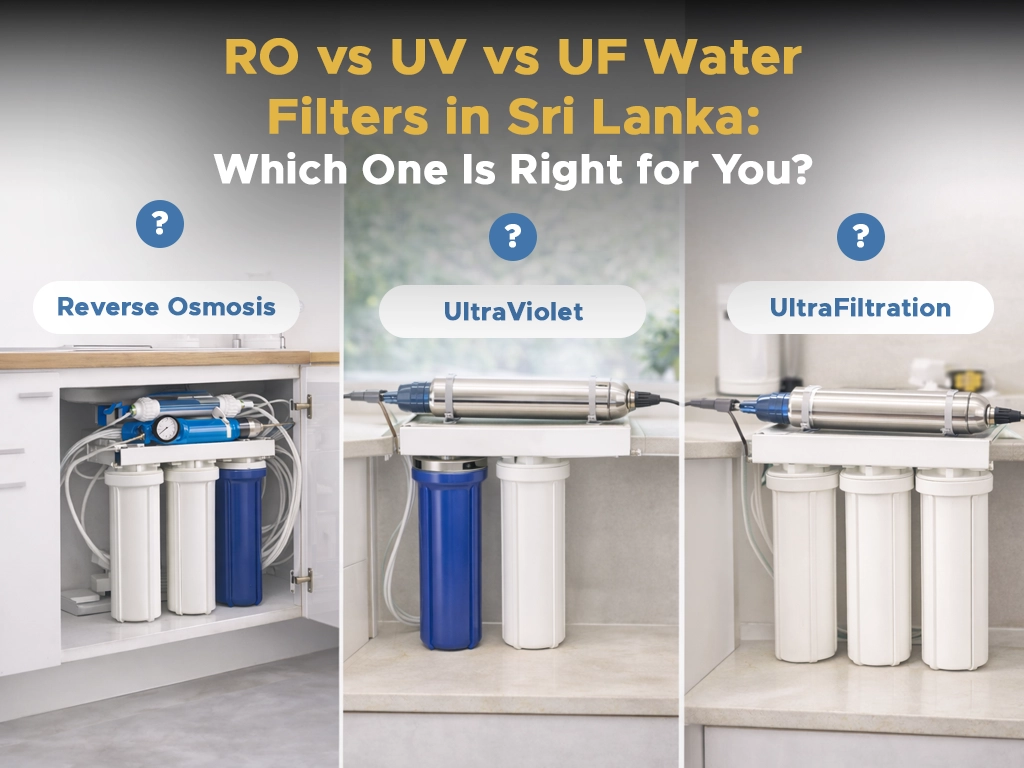
Access to clean and safe drinking water is a growing concern for households across Sri Lanka. From urban areas relying on municipal water supplies to rural regions dependent on wells and tube wells, water quality varies significantly by location. As a result, many homeowners are turning to water filtration systems - but choosing between RO, UV, and UF water filters can be confusing.
Each filtration technology works differently and is designed to solve specific water quality problems. Selecting the wrong system can result in poor water quality, unnecessary costs, or even health risks.
This guide explains RO vs UV vs UF water filters in Sri Lanka in detail - how each system works, what contaminants they remove, where they perform best, and how to decide which one is right for your home.
Sri Lanka’s water challenges are unique and region-specific:
Because of this variation, there is no single “best” water filter for all households. Understanding filtration technologies is essential before investing in a system.
Before comparing systems, it’s important to understand what RO, UV, and UF actually mean.
A physical filtration process that removes dissolved contaminants by forcing water through a semi-permeable membrane.
A disinfection technology that uses UV light to kill bacteria, viruses, and microorganisms.
A membrane-based filtration method that removes suspended particles and microbes without electricity.
Each system solves different water quality problems.
A RO water filter system is one of the most advanced household water purification technologies available in Sri Lanka.
This makes RO water filter Sri Lanka searches very common, especially in dry zone regions.
Despite these limitations, RO filter Sri Lanka demand remains high due to its wide contaminant removal capability.
A UV water filter system focuses on disinfection rather than filtration.
Removes:
Does NOT remove:
Because of this, a UV filter water purifier is best when water is already chemically safe.
In urban Sri Lanka, UV systems are often paired with sediment and carbon filters.
UF (Ultrafiltration) systems use a hollow fiber membrane to physically block contaminants.
What UF Filters Remove
UF does NOT remove:
UF systems are often used in low-pressure or power-limited areas.
Feature
Removes dissolved solids
Removes bacteria & viruses
Removes fluoride
Requires electricity
Produces wastewater
Best for hard water
Mineral retention
RO
Yes
Yes
Yes
Yes
Yes
Yes
With add-on
UV
No
Yes
No
Yes
No
No
Yes
UF
No
Partial
No
No
No
No
Yes
The right system depends on water source and quality.
RO water filter system
These sources often contain high TDS, fluoride, and heavy metals that only RO can remove effectively.
UV water filter system (with sediment + carbon pre-filters)
If water is microbiologically unsafe but chemically acceptable, UV is sufficient.
UF water filter
Suitable for areas with frequent power cuts and relatively clean water sources.
Many modern systems combine technologies:
These hybrid systems offer layered protection and are common in premium products, including some Pureit water filter Sri Lanka models.
Combination systems are useful when:
While RO systems cost more, they often provide better long-term value in high-risk water areas.
RO systems discharge reject water, which can be reused for:
Newer systems, including those promoted by companies like PureHydro, focus on improving water efficiency and reducing waste.
Avoiding these mistakes leads to better health outcomes and cost savings.
Before buying any system, ask:
A water test followed by expert guidance ensures the correct choice.
There is no one-size-fits-all answer when choosing a water filter in Sri Lanka. RO, UV, and UF water filters each serve specific purposes and work best under certain conditions.
Making an informed decision protects not only your drinking water but also your long-term health and household expenses. Brands such as PureHydro emphasize the importance of matching technology to water quality - a principle every homeowner should follow.