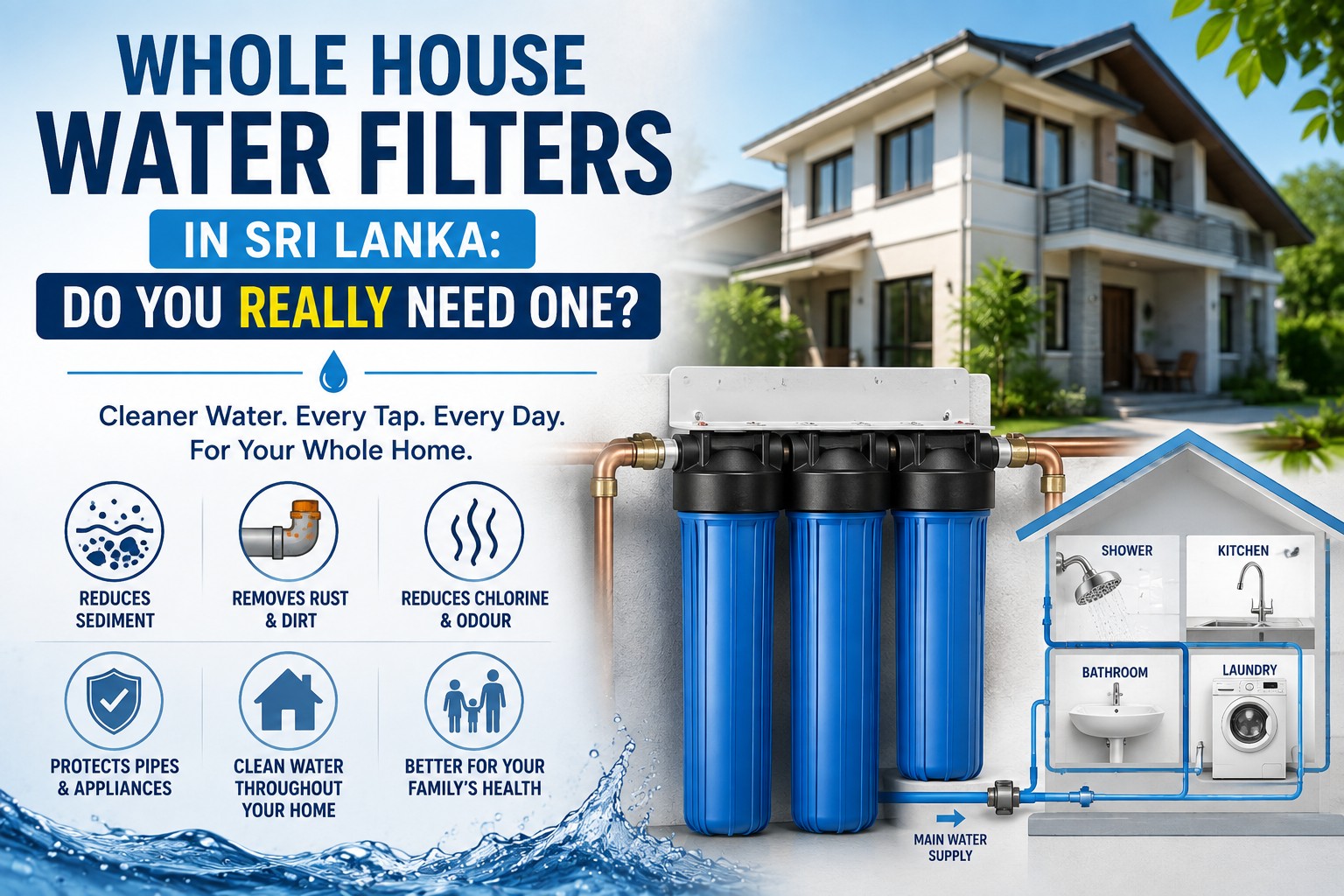
Clean water is essential for drinking, cooking, bathing, cleaning and everyday household activities. While many Sri Lankan households use individual drinking-water filters or bottled water, a different question is becoming increasingly important: Do you really need a whole house water filter?
Whole-house House Water Filters are designed to treat water as it enters a property, rather than filtering water only at one tap. This means filtered water can potentially be supplied throughout the house, depending on the filtration system selected and the quality of the incoming water.
For some households, this can be a practical way to improve water quality throughout the property. For others, a whole-house system may be unnecessary if the existing water supply is already suitable for most household uses.
The right decision depends on your water source, water quality, household size, plumbing system, budget and the contaminants you actually need to address.
A whole house water filter is a water treatment system installed on the main water line entering a property.
Instead of installing separate filters at individual taps, the system treats incoming water before it is distributed throughout the house.
Depending on the system design and filtration media used, a whole-house system may help reduce specific impurities such as:
However, not every whole-house filter removes every type of contaminant.
This is an important point when choosing House Water Filters. The correct system should be selected based on the actual water quality and the treatment objective, rather than simply choosing the system with the largest number of filter stages.
Purehydro provides different water treatment and filtration solutions for residential requirements. You can explore its water filtration products to understand the types of systems available.
There is no universal answer.
A whole-house system may be worth considering if your home experiences water-quality concerns across multiple outlets, relies on a private or less consistent water source, or you want a filtration solution that treats incoming water throughout the property.
However, if your primary concern is drinking water only, a point-of-use drinking-water system may be more appropriate and economical.
The best approach is to first understand your water source and identify the problem you want to solve.
If water contains visible particles, sand or sediment, a suitable whole-house sediment filtration system may help protect household plumbing and appliances while improving the appearance of the water.
Sediment can also accumulate in pipes, taps, showerheads and other fixtures.
Unpleasant odours can have different causes.
For example, chlorine-related odour may be addressed using suitable activated carbon filtration. Other odours may require different treatment.
Therefore, it is important to identify the cause before selecting a filter.
If the same issue appears at the kitchen tap, bathroom, shower and other outlets, filtering only one tap may not solve the broader problem.
A whole-house system treats water at the entry point so that filtration applies to multiple outlets.
Households using groundwater or private water sources may have different filtration requirements compared with homes receiving treated municipal water.
Groundwater quality can vary based on location, geology, surrounding land use and other factors.
If you use a private water source, testing the water before selecting a treatment system is particularly important.
Water containing sediment and certain other impurities can contribute to deposits, clogging and wear in plumbing fixtures and appliances.
A suitable pre-filtration system can help reduce the amount of unwanted material entering the household plumbing system.
Some homeowners simply prefer to have treated water available at multiple outlets rather than relying on a single drinking-water filter.
A whole-house system can provide this type of centralised treatment when appropriately designed.
One of the most common questions is whether a whole house filter is better than a drinking-water filter.
The answer depends on what you want to achieve.
If the objective is simply to improve drinking water, installing a whole-house system may not always be necessary.
If you want to address water quality throughout the property, whole-house filtration may be more suitable.
This depends entirely on the filtration technology.
Different systems are designed for different water-quality problems.
These are designed to reduce physical particles such as sand, dirt and suspended sediment.
Activated carbon can help reduce chlorine, certain organic compounds and unpleasant tastes and odours, depending on the specific filter and water conditions.
Some water sources contain elevated iron or manganese. Specialised treatment systems may be required to address these issues.
Hard water contains minerals such as calcium and magnesium. A water softener uses a different treatment process from a standard sediment or carbon filter.
Reverse osmosis (RO) is a more advanced membrane-based treatment technology and is commonly used when specific dissolved contaminants need to be reduced.
It is important not to assume that a standard whole-house filter can perform RO-type treatment.
The key principle is simple: identify the water problem first, then choose the appropriate treatment technology.
Choosing a water filter should not begin with comparing product prices.
Follow these steps instead.
Determine whether your property receives:
The source provides important information about what types of treatment may be required.
Ask what you are actually trying to improve.
Is the problem:
Different problems require different solutions.
Water testing can provide useful information about physical, chemical and microbiological characteristics.
Depending on the situation, testing may examine factors such as:
Testing is particularly useful for private water sources because water quality can vary considerably.
A small household and a large family may have very different water requirements.
Consider:
The system needs to be appropriately sized for the property's demand.
Do not select a system solely because it has more filtration stages.
A five-stage system is not automatically better than a three-stage system.
The correct system is the one that addresses the actual water-quality problem effectively.
Whole-house systems require appropriate installation on the incoming water line.
Consider available space, pipe size, water pressure, drainage requirements and access for maintenance.
Every filtration system requires some form of maintenance.
Before purchasing, ask:
Understanding ongoing costs is just as important as the initial purchase price.
A typical whole-house filtration setup is installed at or near the point where water enters the property.
A simplified process is:
Main Water Supply → Pre-Filtration → Treatment/Filtration → House Plumbing → Taps & Appliances
The exact configuration depends on the water source and treatment requirements.
The installer identifies where the incoming water line enters the property and determines whether there is sufficient space for the filtration equipment.
The system must be compatible with the property's plumbing configuration and expected water flow.
The selected filtration equipment is connected to the incoming water supply.
The installer checks fittings, valves and connections for leaks.
Depending on the system, initial flushing may be required before normal household use.
Water flow and system performance should be checked before the installation is considered complete.
Professional installation is recommended because incorrect plumbing or poor system sizing can affect performance.
There is no single price for whole-house filtration.
The total cost depends on the type of treatment required, system capacity, filtration media, installation complexity and ongoing maintenance.
A basic sediment filtration setup can have very different costs from a specialised treatment system designed for hard water, iron, microbial concerns or multiple contaminants.
When comparing prices, consider the total cost of ownership, not just the initial purchase price.
This includes:
A cheaper system may not necessarily be the most economical choice over several years.
Maintenance frequency depends on the system type and incoming water quality.
A household with high sediment levels may need more frequent filter replacement than a home with relatively clean incoming water.
Signs that maintenance may be required include:
Always follow the manufacturer's recommended maintenance schedule and replace filtration media or cartridges as required.
This is one of the biggest mistakes.
Without understanding the water quality, you may purchase a system that does not address the actual problem.
No single standard filter removes every possible contaminant.
Filtration technologies have specific capabilities and limitations.
The cheapest system may have higher maintenance costs or may not provide the treatment your household needs.
Some filtration systems can affect flow and pressure. The system should be properly sized for the property.
Replacement filters and servicing should be included in your long-term budget.
Filters need access for replacement, cleaning and inspection. Installation should allow technicians or homeowners to maintain the system conveniently.
A properly selected, installed and maintained water filtration system can be an effective way to manage specific water-quality concerns.
However, safety depends on the source water, system design, installation and maintenance.
A filter should never be assumed to make unsafe water automatically safe for drinking.
If microbiological contamination is suspected, appropriate water testing and treatment should be considered.
They can be worthwhile when a household has water-quality concerns affecting multiple outlets or wants centralised treatment. However, they may not be necessary when the main concern is only drinking water.
Not automatically. The answer depends on the incoming water quality and the type of filtration system installed. A standard sediment or carbon filter should not be assumed to remove every health-related contaminant.
Certain activated carbon filtration systems can reduce chlorine and associated taste and odour. Performance depends on the filter design, water conditions and flow rate.
A standard sediment filter does not soften hard water. Hardness usually requires a dedicated water-softening or other appropriate treatment process.
Not all whole-house filters are designed to remove or inactivate microorganisms. Specific microbiological treatment may be required depending on the water source and test results.
There is no universal lifespan. Filter life depends on the filter type, water quality, household consumption and maintenance schedule.
Some simple systems may appear straightforward, but whole-house systems are connected to the property's main water line. Professional installation can help ensure correct sizing, connections, flow and maintenance access.
The appropriate size depends on household water demand, peak flow rate, pipe size, incoming water pressure and the treatment technology required.
They serve different purposes. Whole-house filtration treats incoming water for multiple household outlets, while a drinking-water purifier is generally designed to provide more targeted treatment at a specific point.
Start by testing the water and identifying your water source and specific concerns. A qualified water-treatment provider can then recommend a system based on the results, household demand and installation conditions.
A whole-house system may be particularly useful for:
However, not every household needs the same level of filtration.
The most practical solution is one based on water quality, household requirements and treatment goals.
So, do you really need whole-house House Water Filters?
If your water-quality concern affects the entire property, a whole-house system may be a practical solution. If your concern is limited to drinking and cooking water, a point-of-use system may be sufficient.
The most important step is not choosing a filter first. It is understanding your water.
Test the water, identify the contaminants or quality concerns, calculate your household demand and then select a filtration system designed for those requirements.
Purehydro provides water filtration and treatment solutions for different residential water needs. If you are unsure which system is suitable for your property, you can contact Purehydro for guidance based on your requirements.