Clean drinking water is no longer a luxury in Sri Lanka — it has become a necessity for households, offices, restaurants, schools, and even small businesses. With increasing concerns about water contamination, chlorine levels, hard water, and water-borne illnesses, more Sri Lankan families are investing in water filtration systems to ensure safe daily drinking water.
One of the most common questions people ask before buying a filtration system is: **How Much Does a Water Filter Cost per Month in Sri Lanka?**
The answer depends on several factors including the type of water filter, filter replacement frequency, household water consumption, electricity usage, and maintenance requirements.
In this guide, we’ll break down the monthly cost of water filters in Sri Lanka, compare different filtration systems, explain hidden expenses, and help you choose the right solution for your budget and needs.
If you are looking for reliable and long-lasting filtration systems, explore the range of water filtration products from Purehydro designed for Sri Lankan homes and businesses.
Over the last few years, demand for water purification systems in Sri Lanka has increased significantly. Several reasons contribute to this trend:
Many people realize that relying on bottled water every day is expensive in the long term. A quality water filtration system often becomes the more economical and healthier solution.
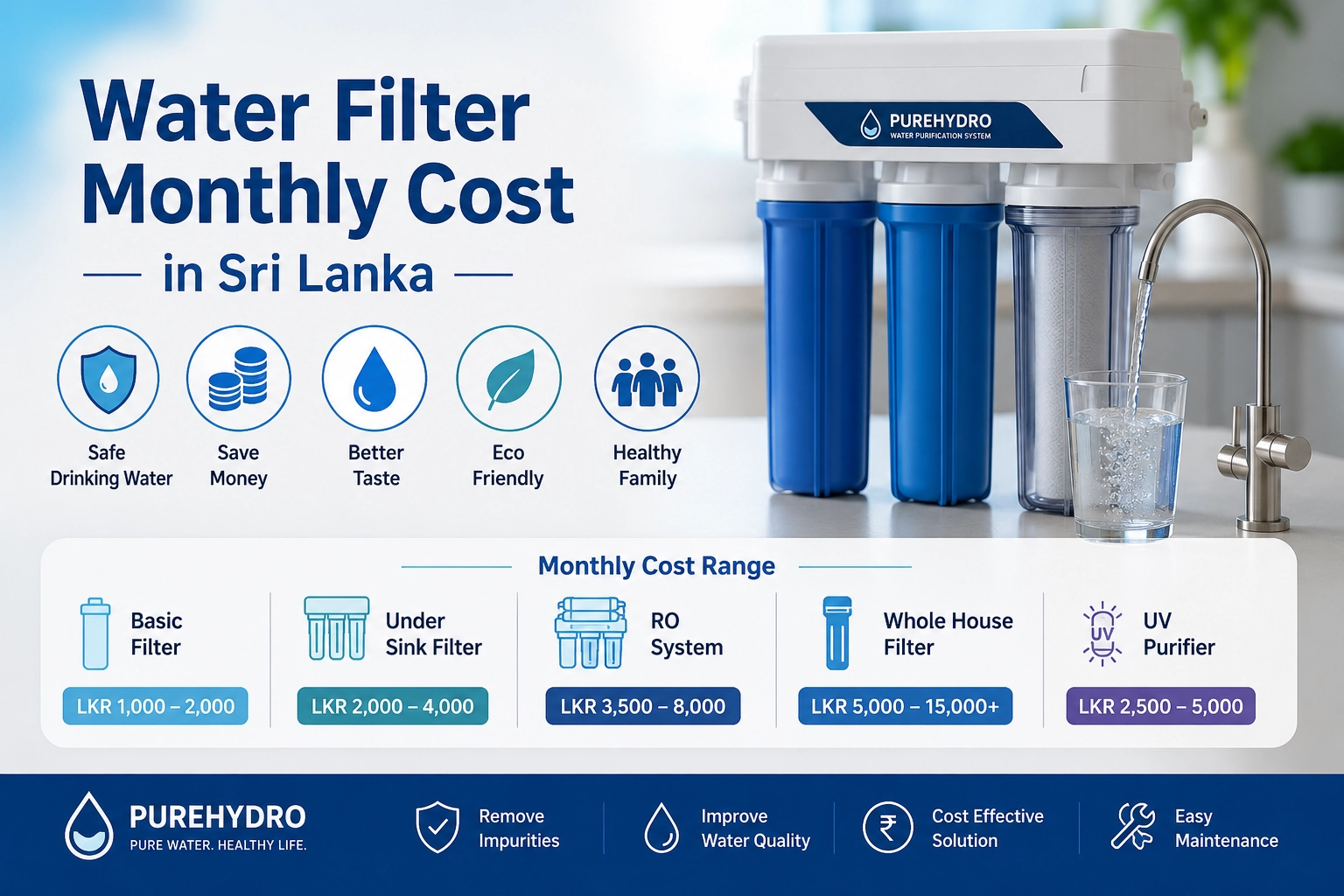
The average monthly cost of a water filter in Sri Lanka ranges from LKR 1,000 to LKR 8,000+, depending on the filtration system and household usage.
Here’s a general breakdown:
Water Filter Type
Basic Carbon Filter
Under Sink Filter
Reverse Osmosis (RO) System
Whole House Water Filter
UV Water Purifier
Estimated Monthly Cost
LKR 1,000 – 2,000
LKR 2,000 – 4,000
LKR 3,500 – 8,000
LKR 5,000 – 15,000+
LKR 2,500 – 5,000
These monthly costs usually include:
Several important factors determine how much you will spend every month on a water filter.
Different filtration technologies have different maintenance requirements.
These are the most affordable options. They mainly remove:
They require low maintenance and are suitable for areas with relatively safe municipal water.
RO systems are more advanced and remove:
They provide very pure drinking water but come with higher maintenance costs.
These systems filter water entering the entire home and are ideal for:
Their maintenance cost is usually higher due to larger filter capacity.
The more water your family consumes, the faster filters need replacement.
For example:
High usage directly increases monthly operating costs.
Poor water quality shortens filter lifespan.
If your water contains:
then filters clog faster and require more frequent servicing.
Homes in areas with hard water often spend more on maintenance than homes with treated municipal water.
Some systems such as:
require electricity to operate.
Although power usage is generally low, it still contributes to monthly costs.
If you already own a filtration system or are planning to buy one, here’s a simple way to estimate your monthly cost.
Example:
Total yearly cost:
LKR 30,000
LKR 30,000 ÷ 12 = LKR 2,500/month
Some systems use electricity worth:
Annual servicing may cost:
Add this into your monthly estimate.
In most cases — yes.
Let’s compare:
A family buying bottled water daily may spend:
Monthly total:
Even premium RO systems usually cost:
This makes filtration systems significantly more cost-effective over time.
Additionally, water filters:
Most filters last:
Lifespan depends on water quality and usage.
Most systems use very little electricity. UV and RO systems may slightly increase your bill, but usually only by a small amount monthly.
RO systems cost more than basic filters because:
However, they provide much higher purification levels.
Yes, especially if your home experiences:
Whole house systems protect:
You can reduce long-term expenses with proper maintenance.
Pre-filters remove sediment before it reaches the main system, helping extend filter life.
Routine servicing improves efficiency and prevents expensive repairs.
Not every home needs an expensive RO system.
For example:
Choosing the correct system avoids unnecessary costs.
Cheap filtration systems may seem affordable initially but often:
Investing in reliable systems from trusted providers helps reduce long-term costs.
Ignoring filter replacement can reduce water quality and damage the system.
Watch for these signs:
Replacing filters on time ensures safe drinking water and lower repair costs.
Before purchasing a water filtration system, consider:
Larger households require higher-capacity systems.
Identify whether you need:
Understand long-term servicing and replacement costs before buying.
When selecting a water filtration provider, reliability and after-sales support matter just as much as the product itself.
Purehydro offers advanced water purification solutions tailored for Sri Lankan conditions, including:
Their systems are designed for durability, efficiency, and long-term cost savings.
If you need help selecting the right filtration system for your home or business, you can contact Purehydro for expert guidance and recommendations.
So, **How Much Does a Water Filter Cost per Month in Sri Lanka?**
The monthly cost typically ranges from:
While the exact cost depends on your water quality, family size, and filter type, water filtration systems are often far more economical than buying bottled water every day.
More importantly, a quality water filter provides:
Choosing the right system and maintaining it properly can help you keep costs manageable while ensuring access to clean, healthy water every day.