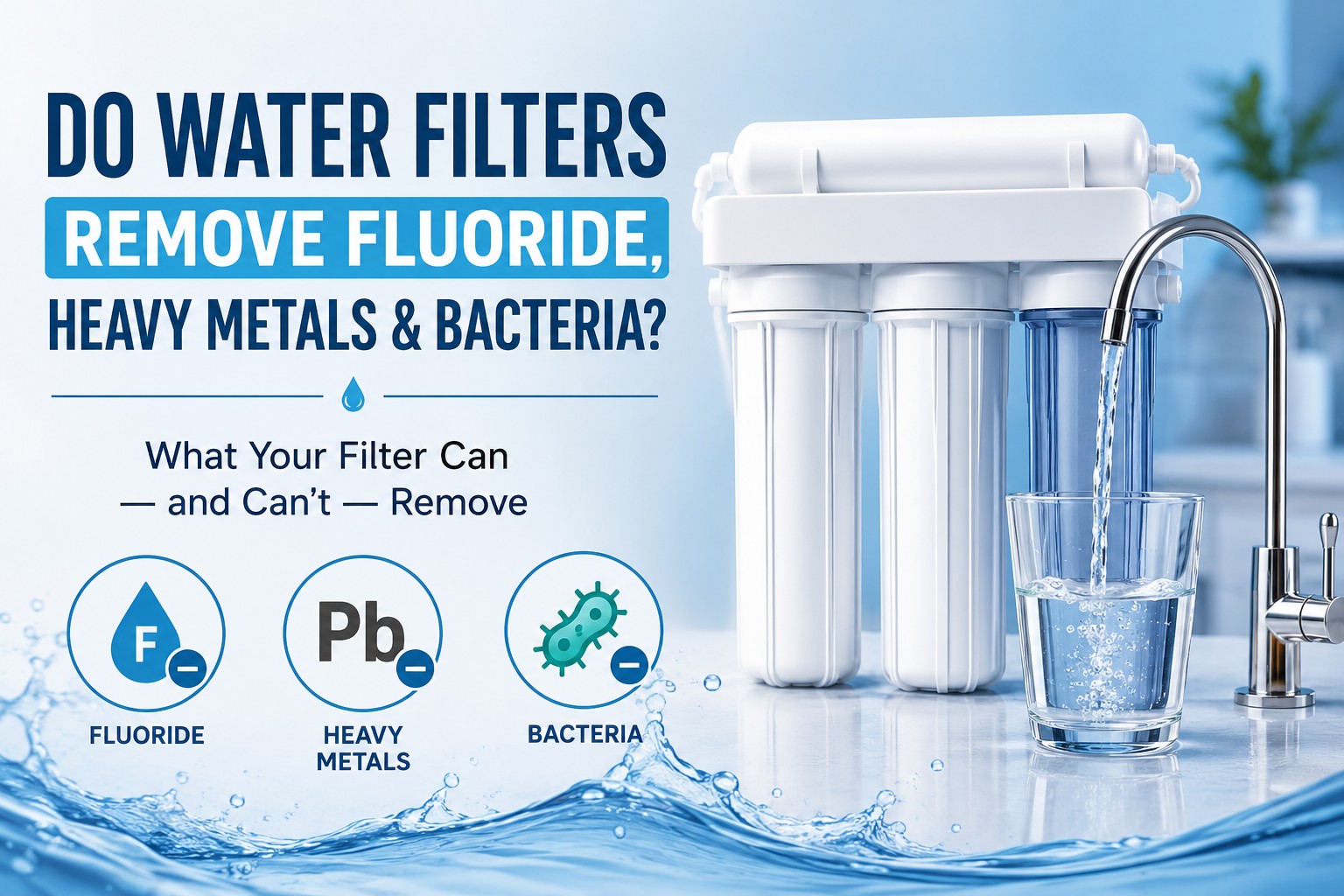
When homeowners consider installing awater filter, one of the most important questions is whether it can removepotentially harmful substances from drinking water.
Do Water Filters Remove Fluoride,Heavy Metals & Bacteria?
The short answer is: some waterfilters can reduce these contaminants, but no single standard water filterremoves everything.
Different filtration technologies aredesigned to target different contaminants. A sediment filter may removesuspended particles, activated carbon can reduce chlorine and certain organiccompounds, reverse osmosis (RO) can reduce many dissolved contaminantsincluding fluoride and some heavy metals, while ultraviolet (UV) treatment caninactivate many microorganisms.
This means choosing a water filtrationsystem should start with the quality of your water and the contaminants youwant to address.
For Sri Lankan households, this isparticularly important because water sources can vary between municipalsupplies, wells, boreholes and other private sources.
The term "water filter" covers many different technologies.
A basic filter may improve the appearanceand taste of water, while a more advanced treatment system may target dissolvedchemicals, heavy metals or microorganisms.
Common water filtration technologiesinclude:
● Sediment filtration
● Activated carbon filtration
● Reverse osmosis
● Ultrafiltration
● Ultraviolet disinfection
● Ion exchange
● Specialised media filtration
Each technology has differentcapabilities.
For example, sediment filtration ismainly designed to remove physical particles. It should not be expected toremove dissolved fluoride.
Similarly, activated carbon can be highlyeffective for certain contaminants but is not a universal solution for heavymetals, fluoride or bacteria.
Some water filtration systems canreduce fluoride, but many common household filters cannot.
Fluoride is a dissolved ion, so simplypassing water through a standard sediment filter does not remove it.
Standard activated carbon filters arealso generally not designed to significantly reduce fluoride.
Reverse osmosis is one of the mostcommonly used household technologies for reducing fluoride.
RO systems use a semi-permeable membrane.Water is forced through the membrane under pressure, while many dissolved substancesare rejected and separated from the treated water.
Depending on the system design andoperating conditions, reverse osmosis can reduce fluoride along with variousother dissolved contaminants.
Certain specialised adsorption media canalso be designed for fluoride reduction.
However, performance depends on:
● Initial fluoride concentration
● Water chemistry
● Filter or membrane quality
● Water pressure
● Flow rate
● System design
● Maintenance
Therefore, claims about fluoride removalshould always be considered in the context of the specific filtration system.
A standard activated carbon filtershould not be assumed to remove fluoride effectively.
Activated carbon is primarily used forcontaminants such as chlorine, certain organic compounds and compoundsresponsible for taste and odour.
Fluoride behaves differently because itis a dissolved inorganic ion.
If fluoride reduction is the objective, asystem specifically designed and tested for fluoride removal should beconsidered.
Some water filtration technologies canreduce specific heavy metals, but performance varies by contaminant and filtertype.
The term "heavy metals" canrefer to several different elements, including:
● Lead
● Arsenic
● Cadmium
● Mercury
● Chromium
● Copper
Different technologies have differenteffectiveness against these contaminants.
Some specialised activated carbonproducts are designed to reduce certain metals, particularly when the carbon ismodified or combined with other treatment media.
However, ordinary carbon filtrationshould not automatically be considered effective against every heavy metal.
Reverse osmosis can reduce many dissolvedinorganic contaminants, including several heavy metals.
Its performance depends on the membrane,feed-water chemistry, operating pressure and system condition.
Ion-exchange systems can also be used totarget specific dissolved ions.
The appropriate technology depends onwhich metal is present and at what concentration.
This depends heavily on the filtrationtechnology.
A standard sediment filter or carbonfilter should not automatically be considered a bacteria-removal system.
Sediment filters can physically removesome larger particles and organisms under certain conditions, but they are notgenerally designed to guarantee microbiological safety.
Some membrane filtration technologies canphysically remove microorganisms, while UV systems use ultraviolet light toinactivate microorganisms.
Ultraviolet water treatment exposesmicroorganisms to UV-C light.
When properly designed and operated, UVtreatment can inactivate many bacteria, viruses and other microorganisms.
However, UV treatment does not removesediment, dissolved chemicals or metals.
This is why UV is often used as part of amulti-stage treatment system rather than as the only treatment method.
RO membranes have very small pores andcan provide a high level of physical separation.
However, an RO system should still beproperly designed, maintained and sanitised.
A complete drinking-water treatmentsystem may combine several technologies to address different types ofcontaminants.
A simple comparison helps explain whythere is no universal filter.
*Performance varies depending on thespecific system, membrane, water chemistry, operating conditions andmaintenance.
The table demonstrates an importantprinciple:
The right water treatment systemdepends on the contaminant you are trying to control.
If you are concerned about fluoride,heavy metals or bacteria, avoid choosing a filter based only on marketingclaims.
Follow this process.
Start by determining where your householdwater comes from.
Common sources include:
● Municipal water supply
● Well water
● Borehole water
● Water storage tanks
● Private water sources
The source can influence whatcontaminants may need to be investigated.
Water testing is one of the mostimportant steps.
Depending on your concerns, testing mayinclude:
● Fluoride
● Lead
● Arsenic
● Iron
● Manganese
● Copper
● pH
● Hardness
● Total dissolved solids
● Turbidity
● Bacterial indicators
Testing provides information that canhelp determine whether treatment is necessary and which technology isappropriate.
Do not simply ask for a "good waterfilter."
Identify what you need to remove orreduce.
For example:
Problem: Highsediment
Possible solution: Sediment filtration
Problem:Chlorine taste or odour
Possible solution: Activated carbon
Problem:Fluoride
Possible solution: Appropriate RO or specialised fluoride treatment
Problem:Certain dissolved metals
Possible solution: RO, ion exchange or specialised media depending onthe metal
Problem:Microbiological contamination
Possible solution: UV, membrane filtration or another suitabledisinfection process
Once the water-quality problem is known,select a technology designed for that contaminant.
This is more reliable than choosing afilter simply because it has multiple stages.
Look for specific information about whatthe system is designed to reduce.
For example, if fluoride is your concern,check whether fluoride reduction is specifically stated and supported byappropriate testing or certification.
A drinking-water system for a smallfamily has different requirements from a whole-house treatment system.
Consider:
● Number of users
● Daily consumption
● Peak demand
● Water pressure
● Storage capacity
● Number of outlets
Advanced filtration systems requireregular maintenance.
Find out:
● How often filters must be replaced
● How often membranes need servicing
● Whether UV lamps requirereplacement
● Whether storage tanks needcleaning
● What ongoing service costs areinvolved
If the treatment system is being used toaddress a known contaminant, periodic testing can help verify that thetreatment continues to perform as intended.
For some households, sediment and carbonfilters may provide useful basic filtration.
A typical combination could be:
SedimentFilter → Carbon Filter → Additional Treatment
The sediment filter reduces physicalparticles.
The carbon filter improves taste andodour and can reduce certain chemical compounds.
However, this combination should notautomatically be considered sufficient for fluoride, every heavy metal ormicrobiological contamination.
If testing identifies a specificcontaminant, the treatment system should be upgraded or configured accordingly.
Reverse osmosis may be considered whenthe primary concern involves dissolved contaminants that conventional sedimentand carbon filtration cannot adequately address.
Depending on the system and waterquality, RO can reduce many dissolved substances, including:
● Fluoride
● Certain heavy metals
● Dissolved salts
● Total dissolved solids
● Certain other inorganiccontaminants
RO is particularly relevant when the goalis high-level treatment of drinking water rather than simply improving tasteand appearance.
However, RO also has considerations suchas:
● Water pressure requirements
● Membrane replacement
● Pre-filtration
● Reject water
● Maintenance
● System capacity
It should therefore be selected based onactual water-quality requirements.
UV treatment may be useful whenmicrobiological contamination is a concern.
UV is different from RO.
RO primarily separates many dissolvedcontaminants from water.
UV uses ultraviolet light toinactivate microorganisms.
UV does not remove dissolved salts,fluoride, heavy metals or sediment.
If water contains both microorganisms anddissolved contaminants, a combined treatment system may be required.
Sometimes a multi-stage system canaddress several categories of contaminants, but it is important to understandthat different stages perform different functions.
A possible treatment arrangement couldinclude:
SedimentFiltration → Carbon Filtration → RO → UV
The sediment stage protects downstreamcomponents.
The carbon stage can improve taste andreduce chlorine and certain organic compounds.
The RO membrane can reduce many dissolvedcontaminants.
The UV stage can provide microbiologicaldisinfection.
The exact configuration should depend onthe water test results.
Not every household needs all fourstages.
Whole-house filtration treats water atthe main entry point before it reaches different outlets throughout theproperty.
This can be useful when the goal is toaddress sediment, chlorine, odour or other water-quality concerns throughoutthe house.
However, advanced drinking-watertreatment such as RO is often used at a specific point of use because itproduces a more highly treated water stream and may have lower flow rates thantypical household demand.
The right approach depends on whether youwant:
● Basic treatment throughout thehome
● High-level drinking-watertreatment
● Both
They do not.
Fluoride requires a technologyspecifically capable of reducing it.
Activated carbon is highly useful, but itis not a universal chemical removal technology.
Water can look perfectly clear whilecontaining dissolved contaminants or microorganisms that cannot be seen.
Without testing, it is difficult to knowwhich treatment technology is actually required.
A filter's performance can decline whencartridges, membranes or treatment components are not maintained.
The most expensive system is notnecessarily the best system for every household.
The goal is to select the appropriatetechnology for the actual water-quality problem.
There is no single price because watertreatment systems vary considerably.
The total cost may depend on:
● Filtration technology
● Number of treatment stages
● System capacity
● Water-quality requirements
● Installation
● Replacement filters
● Membrane costs
● UV components
● Maintenance
● Water storage requirements
A basic sediment and carbon system canhave very different costs from a specialised RO and UV drinking-water system.
When comparing options, consider both theinitial purchase price and the long-term operating cost.
There is no universal replacementschedule.
Filter life depends on:
● Water quality
● Contaminant concentration
● Household consumption
● Filter capacity
● Flow rate
● System design
● Manufacturer recommendations
Sediment filters may require morefrequent replacement when water contains high levels of particles.
Carbon filters eventually becomesaturated.
RO membranes have their own service life.
UV lamps also require periodicreplacement even when they still appear to be operating.
Following the manufacturer's maintenanceschedule is essential.
Some advanced water treatment systems,particularly properly designed reverse osmosis systems and certain specialisedfiltration technologies, can reduce fluoride. Standard sediment and carbonfilters should not be assumed to remove it effectively.
Standard activated carbon filtersgenerally are not designed to significantly reduce fluoride. Afluoride-specific treatment technology may be required.
Some filtration technologies can reducespecific heavy metals. Reverse osmosis, specialised adsorption media andion-exchange systems can be used depending on the metal and water conditions.
Some filtration and disinfectiontechnologies can remove or inactivate bacteria, but standard sediment andcarbon filters should not automatically be considered sufficient formicrobiological safety. UV and certain membrane technologies can be used formicrobiological treatment.
A properly designed RO system cansignificantly reduce fluoride under suitable operating conditions. Actualperformance depends on the membrane, feed water and system maintenance.
RO can reduce many dissolved heavymetals. Performance varies according to the specific contaminant, membrane andoperating conditions.
No. UV treatment is designed formicrobiological disinfection and does not remove dissolved fluoride.
No. UV does not remove dissolved metals.It is primarily used to inactivate microorganisms.
A sediment filter is not generally asubstitute for a dedicated microbiological treatment system. It may physicallycapture some larger particles, but it should not be relied upon as the solemethod of making microbiologically contaminated water safe.
Boiling does not provide a reliablemethod for removing fluoride and can increase its concentration if significantwater evaporates.
No. Safety depends on the original waterquality, the treatment technology, system performance and maintenance. A filtershould be selected according to the contaminants present.
Start with the water source and awater-quality test. Identify the contaminants that need to be reduced, thenchoose a treatment technology specifically designed for those contaminants.
For Sri Lankan households, the best waterfiltration system is not necessarily the one with the greatest number ofstages.
A better approach is:
Knowyour water source → Test the water → Identify contaminants → Select suitabletechnology → Size the system → Install correctly → Maintain regularly.
For example, a household concernedprimarily about sediment may need a good sediment filter.
A household dealing with chlorine tastemay benefit from activated carbon.
A household with a tested fluoride ordissolved-metal concern may need RO or another specialised treatmenttechnology.
A property with microbiological concernsmay require UV or another appropriate disinfection method.
Some households may require a combinationof these technologies.
Purehydro offers water filtration andtreatment solutions designed for different household water-qualityrequirements. You can explore the available water filtration products to learn more about potential treatment options.
Yes, some water treatment systems canreduce fluoride, heavy metals and bacteria—but the answer depends on thefiltration technology.
Sediment filters are mainly designed forphysical particles.
Carbon filters are useful for chlorine,taste, odour and certain organic compounds.
Reverse osmosis can reduce many dissolvedcontaminants, including fluoride and various heavy metals.
UV treatment can inactivate manymicroorganisms but does not remove dissolved chemicals or metals.
The most important lesson is that thereis no universal water filter that removes everything.
If you are concerned about fluoride,heavy metals or bacteria in your household water, start with testing ratherthan guessing.
Once the water-quality problem isidentified, the appropriate treatment technology can be selected.
Purehydro can help homeowners understandavailable water treatment options and choose a system based on their specificrequirements. If you need professional guidance, contact Purehydro to discuss your water filtration needs.