What Is the Difference Between a Water Filter and a Water Purification System for House?
6 min read
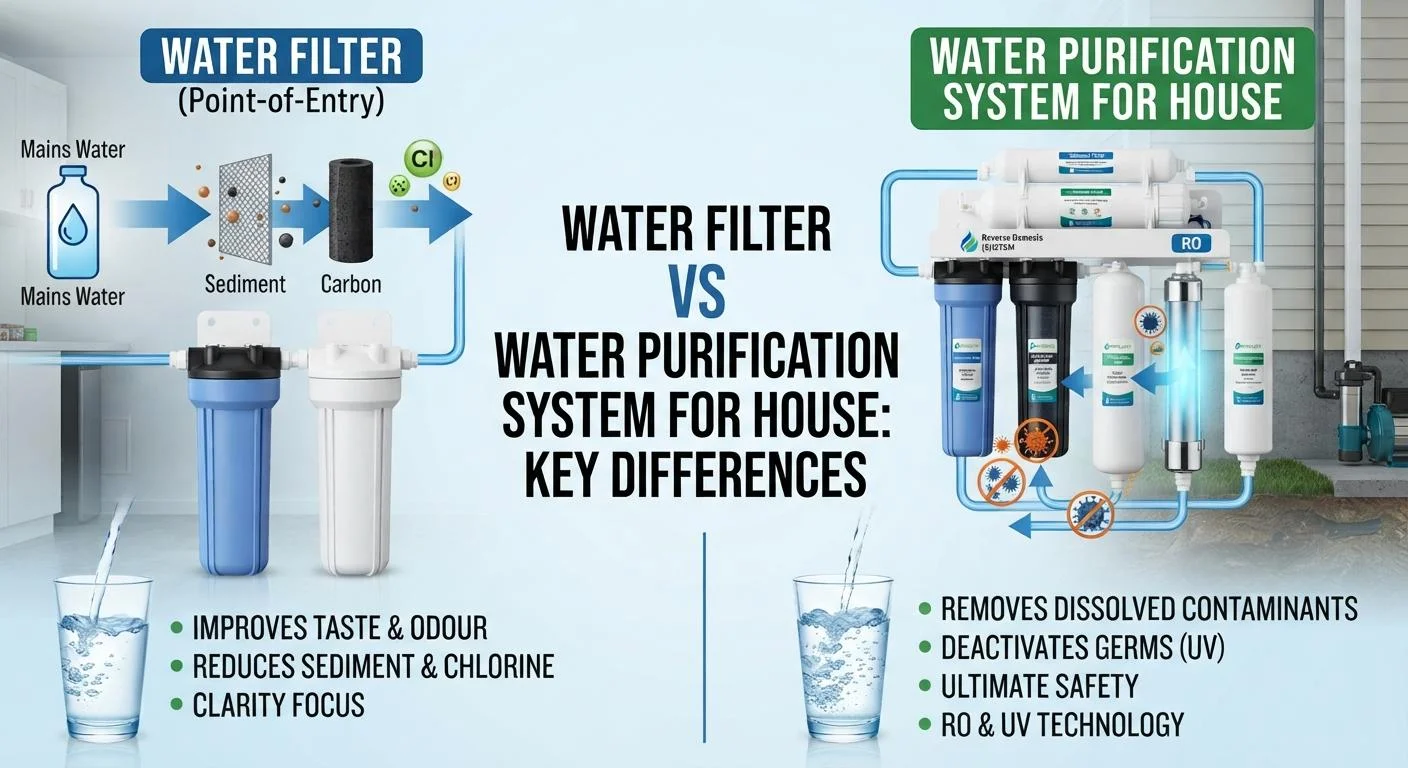
Quick answer: A water filter mainly removes particles and some substances, such as sediment, rust, chlorine and bad taste. A water purification system goes further by adding treatment steps that deal with germs and dissolved contaminants, such as UV disinfection or reverse osmosis. In practice, a filter improves clarity and taste, while a water purification system for house use is built to make water safer to drink. The terms are used loosely by sellers, so always check exactly what a product removes.
If you are comparing options, the right choice depends on your water source and what a test shows. This guide from Purehydro explains the difference in plain language, shows a side-by-side comparison, and walks you through how to choose.
What Is a Water Filter?
A water filter passes water through one or more media that trap or adsorb unwanted substances. Common types include:
- Sediment filters, which remove sand, silt, rust and other visible particles
- Activated carbon filters, which reduce chlorine, odour, taste problems and some organic chemicals
- Ceramic or fine membrane filters, which can block certain particles and microbes depending on their rating
Filters are usually simple, low-cost and easy to maintain. Their limitation is that a basic sediment or carbon filter does not reliably remove dissolved salts, fluoride or all germs.
What Is a Water Purification System for House Use?
A water purification system combines several treatment stages to reduce a wider range of contaminants. It typically starts with filtration, then adds one or more purification steps:
- Reverse osmosis (RO): forces water through a very fine membrane to reduce many dissolved salts and minerals, including fluoride and, to varying degrees, nitrate.
- UV disinfection: uses ultraviolet light to inactivate bacteria, viruses and other microbes in clear water.
- Other stages: such as softening for scale or extra carbon for chemicals.
In testing standards, a true microbiological purifier must meet strict targets. The US EPA protocol requires at least 6-log reduction of bacteria, 4-log of viruses and 3-log of cysts, which is why a purifier is held to a higher bar than an ordinary filter.
Water Filter vs Water Purification System: Side-by-Side
| Feature | Water filter | Water purification system |
|---|---|---|
| Main job | Improves clarity, taste and odour | Makes water safer by dealing with germs and dissolved contaminants |
| Typical stages | One or two (sediment, carbon) | Multi-stage (sediment, carbon, plus RO and/or UV) |
| Removes particles and sediment | Yes | Yes |
| Reduces chlorine and odour | Yes, with carbon | Yes |
| Handles bacteria and viruses | Usually not, unless specifically rated | Yes, with UV or a rated microbiological stage |
| Reduces dissolved salts and fluoride | No (basic filters) | Yes, with RO |
| Cost | Lower | Higher |
| Maintenance | Cartridge changes | Cartridges, membranes, lamps and servicing |
| Best for | Treated mains water with taste or sediment issues | Wells, boreholes, tanks or any source with germ or chemical concerns |
5 Key Differences Explained
1. What They Remove
A filter focuses on what you can see, smell or taste. A purification system aims to address what you cannot, including microbes and dissolved substances.
2. How Many Treatment Stages They Use
Filters often have one or two stages. A water purification system usually combines three or more, which is why it can cover more problems.
3. How They Deal With Germs
Filtration by itself does not guarantee the removal of bacteria and viruses. Purification adds disinfection, such as UV, or uses a filter that has been tested against microbial targets. UV only works when the water is already clear, so a sediment filter normally sits in front of it.
4. How They Handle Dissolved Chemicals
UV does not remove chemicals, and basic filters do not remove dissolved salts. RO membranes can reduce many dissolved contaminants, including fluoride, though performance varies with the system and your water, and RO units usually send some water to drain.
5. Cost and Upkeep
Filters are cheaper to buy and run. Purification systems cost more and need more servicing, such as lamp replacement, membrane changes and sleeve cleaning.
How to Choose: Step by Step
Step 1: Identify Your Water Source
Mains, well, borehole, spring, rainwater or storage tank water each carry different risks. Untreated sources need more than a basic filter.
Step 2: Test Your Water
Test for turbidity, pH, hardness, total dissolved solids, iron, nitrate, fluoride and microbial contamination. The result decides what you need.
Step 3: Match the Problem to the Treatment
| Problem found | Likely treatment |
|---|---|
| Sand, rust, cloudiness | Sediment filter |
| Chlorine taste or odour | Activated carbon |
| Bacteria or viruses | UV or another microbiological stage |
| High fluoride, nitrate or dissolved solids | RO |
| Hardness scale | Softener or RO |
Step 4: Decide Between Point-of-Use and Whole-House
A drinking-water unit at one tap is often enough for safe drinking and cooking. A whole-house setup protects all outlets from sediment and scale. See the available water purification system for house options on Purehydro’s products page.
Step 5: Check Performance Claims and Certification
Ask for test data and certification that match the claims. A product labelled “purifier” should show what it is tested to remove.
Step 6: Plan Installation and Servicing
Confirm installation, warranty, spare parts availability and servicing costs before you buy.
Step 7: Maintain and Re-Test
Replace consumables on schedule and test again from time to time, especially after floods or plumbing work.
Which One Does Your Home Need?
- Treated mains water with a chlorine taste: a carbon filter may be enough
- Cloudy or sandy water: start with a sediment filter
- Well, borehole or spring water: a water purification system, chosen from test results
- High fluoride or dissolved solids: RO as part of a purification system
- Concerns about germs: a system with UV or tested microbial protection
- Water tested and within guidelines: you may need little or nothing
Most Searched Questions About Filters and Purifiers
What is the main difference between a water filter and a water purifier?
A filter removes particles and some substances, while a purifier adds treatment that deals with germs and dissolved contaminants. The exact difference depends on the technology used.
Is a water purifier better than a water filter?
It is better if you need to deal with germs or dissolved contaminants. If your water is already microbiologically safe and you just want better taste, a filter may be enough.
Does a water filter make water safe to drink?
Not always. A filter may improve clarity and taste without removing bacteria, viruses or dissolved chemicals.
Does reverse osmosis remove bacteria?
RO membranes can physically block microorganisms, but a household RO unit is not automatically a certified microbiological purifier. Many systems add UV to cover this.
Does UV remove chemicals?
No. UV inactivates microbes but does not remove chemicals or metals, and it needs clear water to work properly.
Do I need both a filter and a purifier?
Most purification systems already include filtration stages. A filter in front protects the later stages and helps them work properly.
Common Mistakes to Avoid
- Assuming the words “filter” and “purifier” mean the same thing on every label
- Using UV on cloudy water
- Buying a system before testing the water
- Ignoring maintenance schedules
- Expecting one stage to remove every contaminant
Frequently Asked Questions
Can a filter be upgraded to a purification system?
Often, yes. You can add stages such as UV or RO to a filtration setup, depending on the design.
Do purification systems waste water?
RO systems typically send some water to drain, and the amount varies by design. UV and filtration stages do not.
Does purified water lose minerals?
RO reduces dissolved minerals along with contaminants, which can make water taste flatter. Your diet is the main source of minerals for most people.
How often should I service a purification system?
Follow the manufacturer’s schedule. Sediment and carbon cartridges are replaced more often, while UV lamps and RO membranes last longer.
Is a purification system worth it for an apartment?
It can be, particularly when water passes through shared tanks. Testing will show whether a simple filter or a fuller system is the better match.
Choose With Confidence
The best decision starts with knowing your water. Test it, match the treatment to the results and check what each product can prove. To talk through your options, contact Purehydro to find the right water purification system for house use in your home.
Not sure which purifier fits your water?
Our team offers free water testing and consultation across Sri Lanka.