Is an RO Water Filter System Suitable for Every Home in Sri Lanka?
7 min read
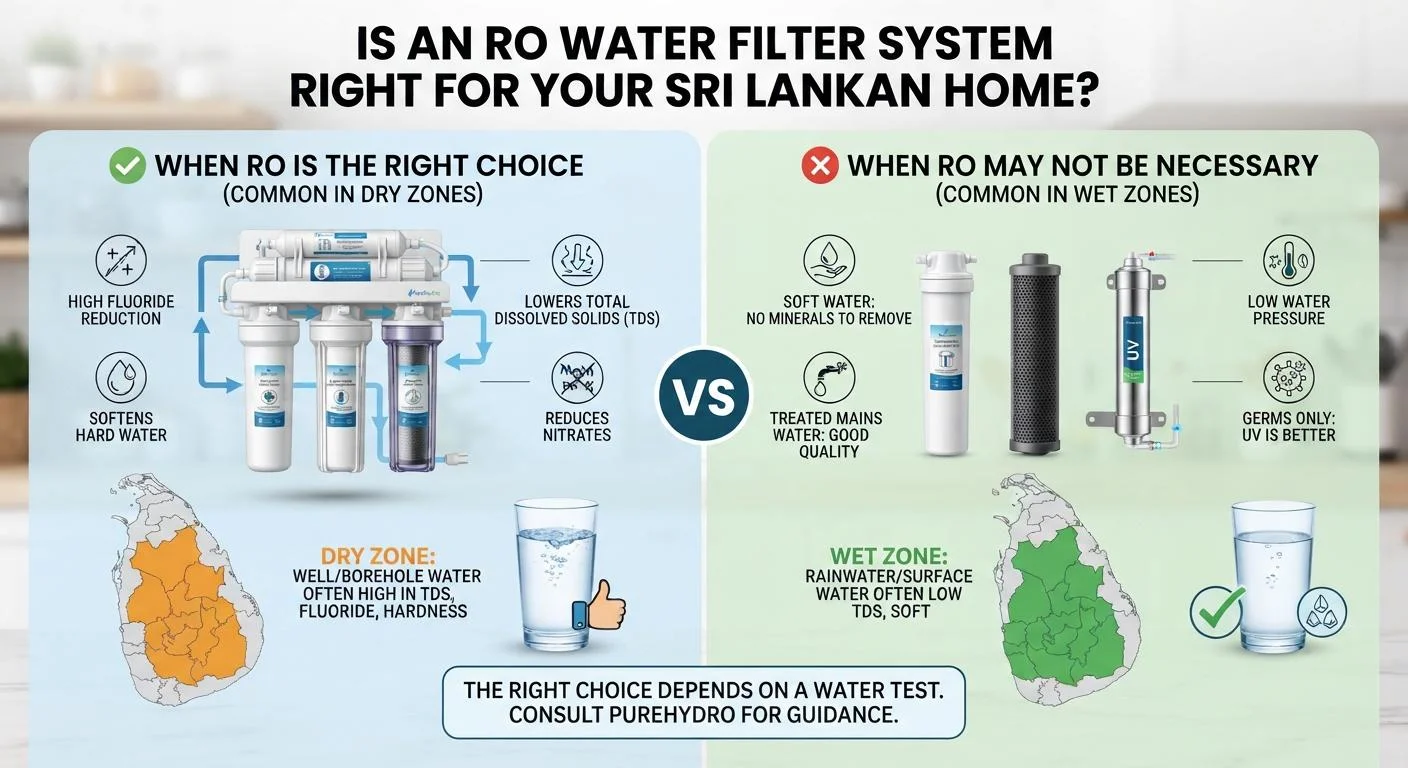
Quick answer: No. An RO water filter system for home use is an excellent fit for households with high dissolved solids, fluoride or hardness, which is common with dry-zone wells and boreholes. It is often unnecessary for homes with soft, low-mineral water, where a sediment filter, carbon filter or UV unit may do the job without stripping minerals. RO also needs adequate water pressure, regular servicing and a plan for reject water. The right choice depends on a water test, not on a general rule.
Reverse osmosis is popular, but it is not a one-size-fits-all answer. This guide from Purehydro explains when RO suits a Sri Lankan home, when it does not, and how to decide in a few clear steps.
What Is an RO Water Filter System for Home Use?
Reverse osmosis uses pressure to push water through a semipermeable membrane. The membrane lets water pass while rejecting many dissolved salts and other substances, which are carried to the drain as concentrate. A typical household unit (sometimes sold as a water purifier system for house use) combines several stages:
- Sediment filter to remove particles that could clog the membrane
- Carbon filter to remove chlorine that can damage the membrane
- RO membrane to reduce dissolved salts and many contaminants
- Post-carbon filter to polish taste
- Optional UV stage to add disinfection, since an RO unit is not automatically a microbiological purifier
Why Sri Lanka Needs a Careful Answer
Water quality in Sri Lanka varies sharply by region. Studies describe different groundwater types across the climatic zones, with elevated hardness, fluoride and salinity reported in dry-zone groundwater. One study found fluoride in dry-zone groundwater reaching high levels compared with much lower levels in the wet zone. Another found that alkalinity, total dissolved solids, hardness and magnesium exceeded safe drinking limits in over half the samples from wells in a dry-zone area studied for chronic kidney disease of unknown cause (CKDu), a condition whose causes researchers are still investigating.
Groundwater also matters because many people rely on it. A significant share of the population uses dug wells and tube wells as their main source. This is why the question is not “Does everyone need RO?” but “What is in my water?”
When an RO Water Filter System Suits Your Home
RO is most useful in these situations:
| Situation | Why RO may help |
|---|---|
| High fluoride in well or borehole water | RO membranes can reduce fluoride |
| High total dissolved solids (TDS) or salinity | RO is designed to reduce dissolved salts |
| Hard, mineral-heavy water | RO reduces many dissolved minerals at the drinking tap |
| High nitrate from farmland runoff | RO can reduce nitrate, although performance varies |
| Concerns about several dissolved contaminants at once | RO covers a wider range than basic filters |
When RO May Not Be the Best Fit
| Situation | Better starting point |
|---|---|
| Soft, low-TDS water from a wet-zone source | Sediment and carbon filtration, with UV if germs are a concern |
| Treated mains water with a chlorine taste | Activated carbon filter |
| Cloudy water or visible particles only | Sediment filter first |
| Bacterial contamination only | UV disinfection, after filtration |
| Very low household water pressure | Booster pump or a different treatment option |
| Little ability to maintain or service the unit | A simpler system that you can keep up |
Water that is already low in minerals does not benefit from having them removed. The World Health Organization has reviewed the health risks of drinking demineralised water, and the mineral content of drinking water is only part of your intake, since food supplies most calcium and magnesium. Some households add a remineralisation stage, and others simply choose treatment that matches their test results.
RO Requirements Every Household Should Check
Water Pressure
RO is a pressure-driven process. Typical home units work best at around 40 to 80 psi, and a booster pump is often recommended when pressure is low. Homes fed from rooftop tanks should check the pressure at the tap.
Reject Water
RO sends part of the feed water to the drain. The ratio varies with pressure, temperature and the TDS of your water, so a claimed “1:1” ratio is not guaranteed in every home. Higher TDS usually means more reject water.
Servicing and Parts
Sediment and carbon stages need regular changes to protect the membrane, and the membrane itself is replaced every few years. Ask for the full maintenance schedule and cost before you buy.
Disinfection
An RO membrane can physically block microorganisms, but a household unit is not automatically a certified purifier. If germs are a concern, choose a unit with UV or another tested microbiological stage.
How to Decide: Step by Step
Step 1: Identify Your Water Source
Note whether you use mains, a well, a borehole, a tank or a mix, and which part of the country you live in.
Step 2: Test Your Water
Ask a laboratory to test TDS, fluoride, hardness, nitrate, iron, pH, turbidity and microbial contamination. The result tells you whether RO is the right tool.
Step 3: Compare Results With Guidelines
WHO guideline values include fluoride at 1.5 mg/L and nitrate at 50 mg/L. If your results are above these, RO deserves serious consideration.
Step 4: Check Water Pressure and Space
Measure pressure at the tap where the unit will sit, and check that you have room under the sink or for a wall-mounted unit.
Step 5: Choose the Right Configuration
Decide whether you need RO alone, or RO with UV, and whether to treat only drinking water or the whole house. You can compare the available RO water filter system for home options on Purehydro’s products page.
Step 6: Plan Maintenance
Set a calendar for cartridge, membrane and lamp changes, and re-test your water from time to time.
Most Searched Questions About RO Water Filter Systems
Is an RO system necessary for every home?
No. It is most useful where tests show high TDS, fluoride, hardness or nitrate. Homes with soft or already-treated water may not need it.
Does RO remove fluoride?
Yes, RO can substantially reduce fluoride, but the exact removal depends on the system and your water. Check the performance claims and your test results.
Does RO remove bacteria?
RO membranes can block microorganisms, but a household RO system is not automatically a microbiological purifier. A UV stage is commonly added for disinfection.
Does an RO system waste water?
Yes. Part of the incoming water goes to the drain as reject water. The amount varies by system design, pressure and water quality.
Does RO remove essential minerals?
It removes most dissolved minerals, including calcium and magnesium. Most of your daily intake of these minerals comes from food, but very low-mineral water is not ideal as your only source for long-term drinking, so some people choose a remineralisation stage.
Does RO need electricity?
Many systems rely on mains pressure, but a booster pump, UV lamp or electronic controls need power.
Is RO water safe to drink every day?
RO water is widely used, but the right approach depends on your source water and diet. If you have concerns, discuss them with a health professional.
Common Mistakes to Avoid
- Buying RO without testing the water first
- Installing it where water pressure is too low
- Ignoring reject water and drainage
- Skipping carbon and sediment changes, which shortens membrane life
- Assuming RO alone guarantees germ-free water
- Using RO on soft water that does not need it
Frequently Asked Questions
Can RO be used for the whole house?
Household RO units are usually installed at the drinking tap. Whole-house RO is a larger and costlier setup, and most homes use RO for drinking and cooking only.
Can I combine RO with other treatments?
Yes. RO is often paired with sediment, carbon and UV stages so that each handles a different problem.
How long does an RO membrane last?
Often several years, depending on feed water, usage and how well the pre-filters are maintained.
What if my water pressure is low?
Ask about a booster pump or a model designed for low pressure before buying.
What should I ask before buying an RO system?
Ask what it removes, its reject water ratio at your pressure, its maintenance costs, whether it includes UV, and who installs and services it.
Choose the Right Treatment for Your Home
An RO system can be the right answer, but only when your water and your home suit it. Start with a test, check your pressure, and match the technology to the results. To discuss your options, speak with Purehydro about the right RO water filter system for home use in your situation.
Not sure which purifier fits your water?
Our team offers free water testing and consultation across Sri Lanka.