How Often Should You Replace Filters in a Water Purifier System for House?
6 min read
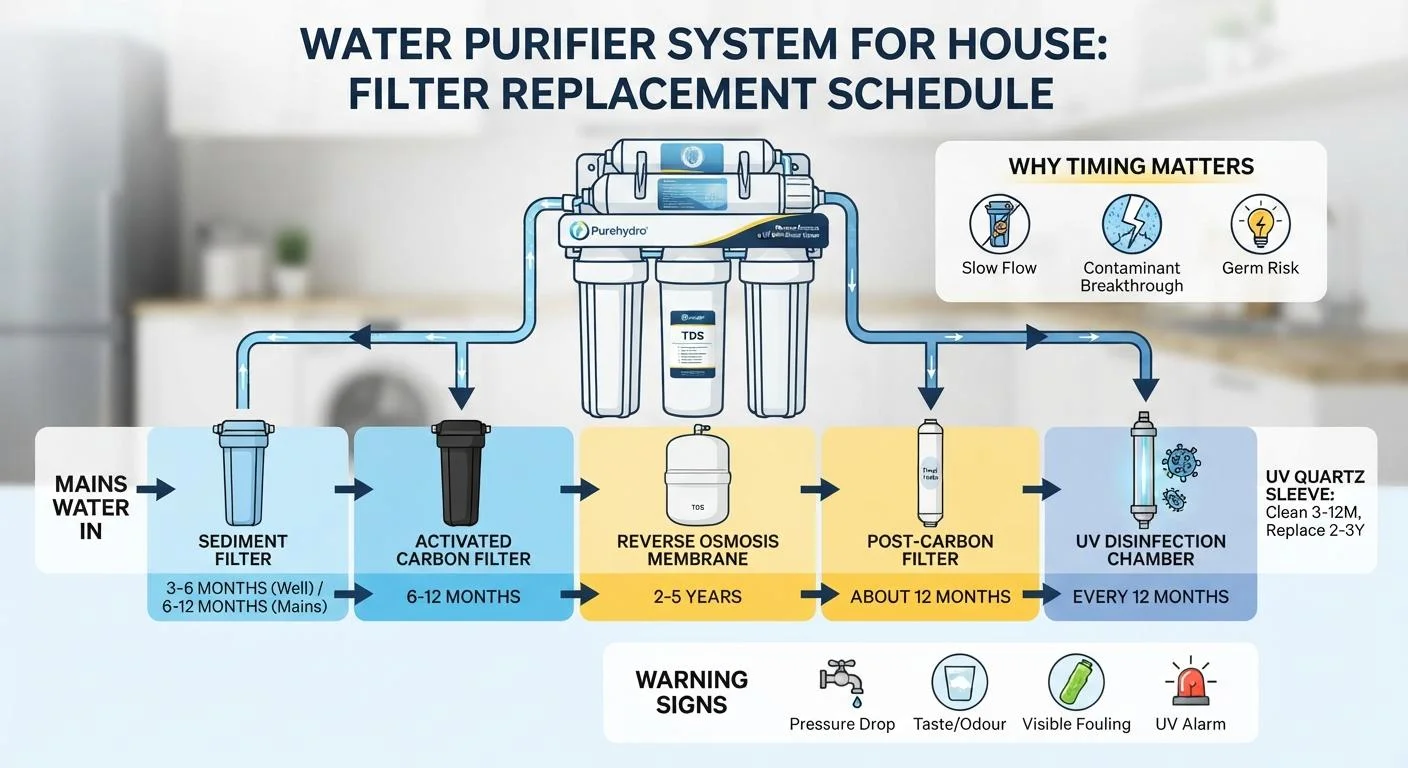
Quick answer: As a general guide, replace sediment filters every 3 to 12 months, carbon filters every 6 to 12 months, RO membranes every 2 to 5 years, and UV lamps every 12 months, even if the lamp still glows. Your exact schedule depends on your water source, how much water you use and your manufacturer’s instructions. Homes on wells or borehole water, or with cloudy water, usually need changes more often. Always follow the schedule for your own model, and shorten it if flow slows or taste changes.
A water purifier system for house use is only as reliable as its worn parts. A clogged or exhausted filter can stop doing its job without any warning. This guide from Purehydro explains typical replacement intervals, the signs that a change is overdue, and how to build a simple maintenance routine.
Typical Replacement Schedule
These ranges are general starting points. Manufacturer guidance for your model always comes first.
| Component | What it does | Typical replacement interval |
|---|---|---|
| Sediment filter | Traps sand, silt and rust | 3 to 6 months in whole-house or high-sediment homes; 6 to 12 months in under-sink systems |
| Activated carbon filter | Reduces chlorine, odour and some chemicals | 6 to 12 months |
| RO membrane | Reduces dissolved salts and many contaminants | 2 to 5 years, depending on water and usage |
| Post-carbon (polishing) filter | Final taste and odour polish | About 12 months |
| UV lamp | Inactivates bacteria and viruses | Every 12 months (about 9,000 hours) |
| UV quartz sleeve | Protects the lamp and lets UV light through | Clean every 3 to 12 months; replace every 2 to 3 years |
Why Replacement Timing Matters
Filters work by trapping or adsorbing contaminants, so they eventually fill up. When that happens, several things can go wrong:
- Reduced protection: an exhausted carbon filter stops absorbing chlorine and other substances.
- Slow flow: a clogged cartridge restricts water and pressure.
- Damage to other parts: if the carbon stage is spent, chlorine can reach the RO membrane and shorten its life.
- Bacterial growth: damp filter media can harbour bacteria when left too long.
- Weaker UV performance: a UV lamp loses intensity over time, and a glowing lamp is not proof that it is still disinfecting properly.
What Affects How Often You Need to Replace Filters?
Water Source
Well and borehole water usually carries more sediment, iron and hardness, so pre-filters often need changing every 3 to 6 months. Treated mains water is generally gentler on filters.
Water Usage
A large family that fills containers several times a day will use up filter capacity faster than a household of two.
Water Quality
Cloudy water, high iron or high hardness shortens filter life. After floods or heavy rain, check your filters sooner than planned.
System Design
A filter rated by volume, such as a set number of litres or gallons, may need changing earlier than its time interval if you use a lot of water.
How to Set Up Your Replacement Schedule: Step by Step
Step 1: List Every Stage in Your System
Write down each component, such as sediment, carbon, RO membrane, post-carbon, UV lamp and sleeve. Your installer or manual should name them.
Step 2: Note Install Dates
Record when each part was installed. Write the date on the cartridge or put it in your phone calendar.
Step 3: Find the Manufacturer’s Intervals
Use the schedule in your system’s manual as the starting point. If you cannot find it, ask your installer or supplier.
Step 4: Adjust for Your Conditions
Shorten the interval if you use well water, have visibly dirty water, or use a lot of water. Lengthen it only on the manufacturer’s advice.
Step 5: Set Reminders
Add calendar alerts one to two weeks before each change, and keep spare cartridges on hand so you are not waiting for parts.
Step 6: Test the Water Periodically
Check your results with a TDS meter for RO performance and arrange laboratory tests from time to time. A test shows whether the system is working, not just whether it looks fine.
Signs You Need to Replace Filters Early
- Water flow or pressure drops noticeably
- Taste or odour returns, such as chlorine or mustiness
- Water looks cloudy or discoloured
- The filter cartridge looks dark brown, slimy or black
- An RO system runs constantly or produces much less water
- TDS readings rise after the RO membrane
- A UV alarm or lamp-change light comes on
- A bacteria test returns a positive result
How to Replace a Filter Safely
The exact steps vary by model, so follow your manual. In general:
- Switch off the water supply and, for UV, the power.
- Release pressure by opening the tap.
- Remove the old cartridge or lamp carefully.
- Clean the housing and check O-rings and seals.
- Fit the new part and tighten by hand, handling UV lamps with gloves or a clean cloth.
- Restore water and power, check for leaks and flush as the manual directs before drinking.
- Record the date.
If you are unsure, use a qualified technician. UV lamps need careful handling, and you should never look directly at an illuminated lamp. You can compare the range of water purifier system for house options on Purehydro’s products page when planning replacements or upgrades.
Most Searched Questions About Replacing Water Purifier Filters
How often should I change the filter in my water purifier?
Most sediment and carbon filters need changing every 6 to 12 months, sooner for well water or heavy use. RO membranes last longer, and UV lamps are normally changed yearly.
What happens if I don’t change my water filter?
The filter can clog, lose its ability to remove contaminants, slow the flow and in some cases allow bacteria to grow. Water may look and taste fine while protection falls.
How do I know when my RO membrane needs replacing?
Rising TDS readings, much slower output, poor taste or a system that runs constantly are common signs. Time alone is not the best guide, so test performance.
Should I replace a UV lamp that still lights up?
Yes, on schedule. UV output declines over time, so a glowing lamp may no longer deliver the dose needed to disinfect.
How often should I clean the UV quartz sleeve?
At least once a year and often every 3 to 6 months in hard water areas, because mineral coatings block UV light.
Can I use a filter longer than recommended?
It is not advisable. Past its rated life, a filter may protect less and can become a place where bacteria grow.
Common Mistakes to Avoid
- Waiting for water to taste bad before changing filters
- Replacing the RO membrane but ignoring the carbon pre-filters
- Forgetting to replace the UV lamp because it still glows
- Skipping the quartz sleeve cleaning
- Using the same schedule for every home
- Not recording installation dates
Frequently Asked Questions
Do all filters in a system need replacing at the same time?
No. Different stages last different lengths of time. Many households change sediment and carbon together and the membrane and UV parts on their own schedules.
Does well water mean more frequent changes?
Usually, yes. Higher sediment, iron and hardness mean filters clog sooner, so intervals are often shorter.
Can I replace filters myself?
Many cartridge changes are simple, but follow the manual and use a technician for RO membranes or UV work if you are unsure.
Do I need to flush a new filter?
Often yes. Many manufacturers recommend flushing to remove loose carbon fines and air before you drink the water.
How much does replacement cost?
Costs depend on the system and parts. Ask for a service quote, including cartridge prices and how often each part is replaced, before you buy.
Keep Your Water Protected
A regular schedule is the simplest way to keep a purification system working as designed. Record your dates, watch for warning signs and test when in doubt. For advice on servicing or choosing the right water purifier system for house use, speak with Purehydro.
Not sure which purifier fits your water?
Our team offers free water testing and consultation across Sri Lanka.