7 Signs Your House Needs a Water Purification System
7 min read
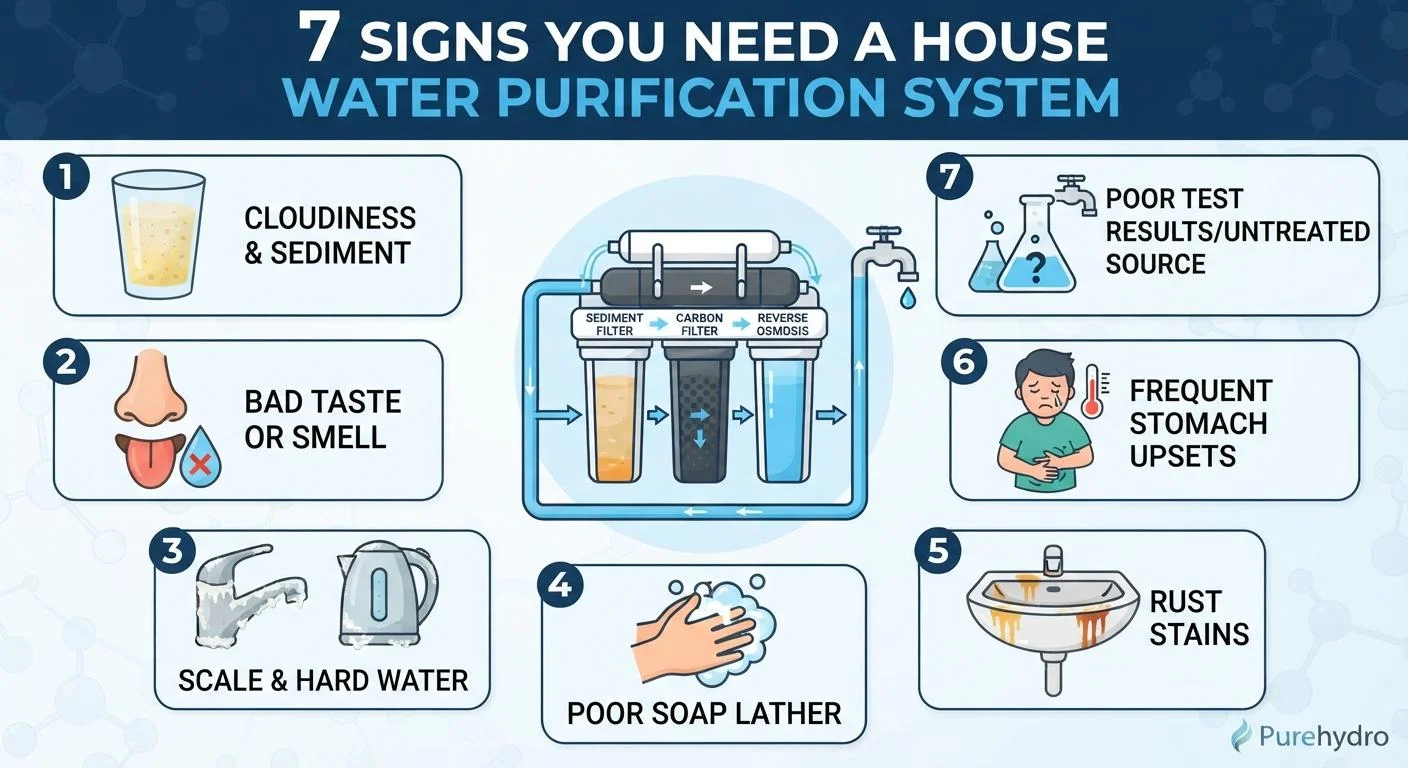
Quick answer: Your home may need a house water purification system if you notice cloudy or discoloured water, a bad taste or smell, white limescale on taps and kettles, soap that will not lather, rust-coloured stains, repeated stomach upsets in the family, or lab results that exceed drinking water guidelines. Some problems are only a nuisance, while others, such as bacteria or high fluoride, cannot be seen or tasted. The safest step is to test your water, then choose a system that targets what the test finds.
Water can look fine and still carry risks, and it can look poor while being safe to drink. This guide from Purehydro explains seven common warning signs, what each one may mean, and how to decide what to do next.
What Is a House Water Purification System?
A house water purification system treats the water entering your home or a drinking tap to improve its safety, taste and clarity. Depending on the problem, it may combine several stages:
- Sediment filtration to remove sand, rust and particles
- Activated carbon to reduce chlorine, odour and some organic chemicals
- Reverse osmosis (RO) to reduce many dissolved salts, including fluoride and nitrate
- UV disinfection to inactivate bacteria and viruses in clear water
- Softening to reduce scale caused by hardness
Filtration removes particles and some substances, while purification usually adds a step that deals with germs or dissolved contaminants.
7 Signs Your House Needs a Water Purification System
1. Your Water Looks Cloudy, Yellow or Brown
Cloudiness is called turbidity, and it comes from suspended particles. It is not always harmful, but it can shelter germs and interfere with disinfection. WHO guidance says turbidity should ideally be below 1 NTU and should not exceed 5 NTU. Water that stays cloudy after settling for a few minutes, or that carries visible particles, deserves attention.
What may help: sediment filtration, plus a water test to check for bacteria.
2. Your Water Smells or Tastes Wrong
A chlorine smell is common in treated water, while a metallic taste often points to iron, and a rotten egg smell may point to sulfur compounds. A salty or bitter taste can indicate high dissolved minerals.
What may help: activated carbon for chlorine and odour, or RO where the issue is dissolved minerals. Persistent bad smells should be tested.
3. White Scale Builds Up on Taps, Kettles and Appliances
Chalky white deposits are a classic sign of hard water, which carries dissolved calcium and magnesium. Scale can reduce appliance efficiency and shorten their lifespan.
What may help: a softener or RO, depending on how the water will be used.
4. Soap Will Not Lather and Skin Feels Dry
Hard water reacts with soap and leaves a sticky film, which is why lather is poor and bathrooms collect soap scum. Many people also report dry skin, dull hair and stiff laundry. These signs can overlap with other causes, such as using too much detergent, so they are clues rather than proof.
What may help: a softener for whole-house hardness problems.
5. You See Rust Stains on Fixtures or Laundry
Orange or brown stains on sinks, toilets and clothes usually point to iron in the water or rusting pipes. Iron has no health-based guideline value from WHO, but it affects taste, appearance and cleaning. Rusting pipes can also indicate an ageing plumbing system.
What may help: sediment or iron-reduction filtration, and a check of your tanks and pipes.
6. Family Members Keep Having Stomach Upsets
Repeated diarrhoea, stomach cramps or vomiting in a household can have many causes, including food. If these problems keep returning, water contamination is one possibility. This is a sign to see a doctor and test your water, not to guess.
What may help: disinfection, such as boiling or UV treatment, along with cleaning storage tanks. UV only works on clear water, so filtration usually comes first.
7. Your Source Is Untreated, or Test Results Exceed Guidelines
Wells, boreholes, springs and rainwater tanks are not treated by a utility, so quality depends on your location and surroundings. WHO guideline values include fluoride at 1.5 mg/L, nitrate at 50 mg/L and arsenic at 0.01 mg/L. You cannot see or taste these. Research in Sri Lanka has found that groundwater chemistry varies widely by district, with hardness, dissolved solids and fluoride high in many dry-zone samples.
What may help: RO and other targeted treatment, chosen after a laboratory test.
How to Decide: Step by Step
Step 1: Write Down What You Notice
Record changes in colour, taste, smell, scale and stains, and note when they happen. Patterns, such as problems after heavy rain, are useful clues.
Step 2: Identify Your Water Source
Note whether the water comes from the mains, a well, a borehole, a tank or a mix. Include how old your tanks and pipes are.
Step 3: Test the Water
Use a reputable laboratory or qualified provider to test the water you drink. Ask for turbidity, pH, hardness, total dissolved solids, iron, nitrate, fluoride and microbial contamination at least.
Step 4: Match the Treatment to the Results
Choose treatment stages that deal with what the report shows, not simply what a seller recommends. Browse the house water purification system options on Purehydro’s products page to see what is available for different needs.
Step 5: Check Installation, Service and Warranty
Ask what the system removes, what it does not remove, how often parts need replacing, what servicing costs and who installs it.
Step 6: Maintain and Re-Test
Replace cartridges, membranes and lamps on schedule. Re-test your water periodically, especially after floods, plumbing work or changes in taste or clarity.
Most Searched Questions About House Water Purification
How do I know if my water is safe to drink?
You cannot be sure by looking, tasting or smelling. Test it in a laboratory for the parameters that apply in your area.
Is cloudy water dangerous?
Not always, but it should not be ignored. Cloudiness can come from harmless air bubbles or from particles that may carry germs, so it is worth testing if it persists.
Does hard water harm your health?
Hard water is mostly a nuisance that causes scale, soap problems and dry skin for some people. Hardness itself is not usually the main health concern, but water in some regions can also contain fluoride or other contaminants that need testing.
Does boiling water purify it?
Boiling kills germs, but it does not remove chemicals such as fluoride, nitrate or hardness minerals.
Does a water filter remove bacteria?
Not unless it includes disinfection or a filter rated for microbial removal. Sediment and carbon filters alone should not be relied on for germs.
How often should I change my filters?
It depends on the filter type and your water. Sediment and carbon cartridges usually need changing sooner than RO membranes and UV lamps. Follow the manufacturer’s guidance.
Common Mistakes to Avoid
- Buying a system before testing the water
- Assuming clear water is safe
- Using UV treatment on cloudy water
- Ignoring dirty storage tanks
- Skipping filter changes
- Treating scale and germs as the same problem
Frequently Asked Questions
Does every house need a water purification system?
No. If your tested water meets guidelines and tastes fine, you may not need one. Homes with untreated sources or visible problems are more likely to benefit.
Should I treat the whole house or just the drinking water?
Whole-house treatment helps with scale, sediment and chlorine at every tap. A drinking-water unit is often enough if your main concern is what you drink and cook with.
Can a purification system fix hard water?
A softener is designed to reduce hardness scale. RO can also reduce dissolved minerals at the drinking tap.
Do apartments need a water purification system?
Possibly. Apartments often store water in shared tanks, so tank hygiene and plumbing age can affect quality.
What should I ask before buying a system?
Ask what it removes, what it does not remove, what maintenance it needs, what it costs to run, and who services it.
Take the Next Step
If you have noticed one or more of these signs, start with a test and a clear picture of your water. Speak with Purehydro about choosing the right house water purification system for your home’s source, usage and budget.
Not sure which purifier fits your water?
Our team offers free water testing and consultation across Sri Lanka.